Physical Address
304 North Cardinal St.
Dorchester Center, MA 02124
Physical Address
304 North Cardinal St.
Dorchester Center, MA 02124

 BySandy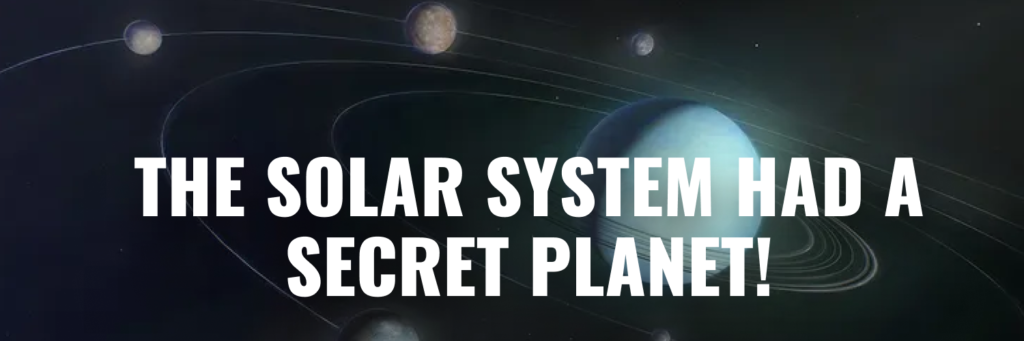
For decades, astronomers have suspected that our Solar System may not have always looked the way it does today. The giant planets—Jupiter, Saturn, Uranus, and Neptune—likely formed much closer together before gradually migrating to their current positions.
Now, new research suggests that an additional giant planet may once have been part of the Solar System. Although that world is long gone, its existence may explain why Jupiter and Uranus still have their moons today.
Scientists believe the outer Solar System experienced a chaotic period billions of years ago. During this time, the giant planets interacted gravitationally with one another, shifting their orbits and reshaping the architecture of the planetary system.
To better understand this turbulent era, researchers ran 122 simulations of the early Solar System using different combinations of giant planets and migration scenarios.
Their goal was simple: determine which planetary arrangements could evolve into something resembling the Solar System we observe today.
But there was one important detail they paid close attention to—the moons of Jupiter and Uranus.
Unlike many smaller objects in the Solar System, the major moons of Jupiter and Uranus have likely remained in relatively stable orbits for billions of years.
These moons act like ancient fossils, preserving clues about events that occurred during the Solar System’s infancy.
If the giant planets experienced violent close encounters while migrating, their gravitational forces could have disrupted moon systems entirely. Moons might have collided with each other, crashed into their planets, or been ejected into space.
Surprisingly, the simulations revealed exactly that.
Jupiter’s moon system survived in fewer than 15% of scenarios. Uranus’s moons fared even worse, surviving in only about 9% of simulations.
Even more remarkably, scenarios that favored Jupiter’s moons often destroyed Uranus’s moons, and vice versa.
The odds of both planetary moon systems surviving together were extremely low.
Researchers discovered that the most successful simulations shared one feature: an extra ice giant planet.
Instead of starting with the four giant planets we know today, these models began with five.
This additional world was similar in size to Uranus or Neptune and orbited among the other giant planets during the Solar System’s early history.
Its presence subtly altered the gravitational interactions between the planets, changing the timing and intensity of their migrations.
As a result, Uranus avoided several potentially destructive encounters, while Jupiter’s moons experienced less severe disruptions.
The extra planet effectively acted as a gravitational buffer, increasing the chances that both moon systems could survive.
If this fifth giant planet once existed, where is it now?
According to the simulations, the most likely answer is that Jupiter eventually ejected it from the Solar System.
A close gravitational encounter could have accelerated the planet to escape velocity, sending it drifting into interstellar space.
Rather than orbiting the Sun, the planet would have become a rogue world—wandering alone through the darkness between the stars.
Astronomers have discovered many rogue planets throughout the Milky Way, making the idea far from impossible.
In fact, one of those lonely worlds could theoretically be a former member of our own Solar System.
One of the most intriguing conclusions from the study is how unlikely our present-day Solar System may be.
The simulations suggest that many alternative histories result in missing moons, drastically different planetary arrangements, or complete instability.
The Solar System we inhabit appears to be the product of a very specific sequence of events.
A small change—such as the absence of an extra ice giant—might have left Jupiter and Uranus without the moon systems we observe today.
Despite the compelling results, researchers caution that computer simulations cannot perfectly reconstruct events that occurred billions of years ago.
Planetary evolution is inherently chaotic, and even tiny differences in starting conditions can produce dramatically different outcomes.
Rather than providing a definitive answer, the study offers a strong clue about the Solar System’s distant past.
Whether or not a fifth giant planet truly existed, the evidence suggests that our planetary neighborhood may have been far more crowded—and far more chaotic—than it appears today.
And somewhere beyond the reach of the Sun’s gravity, a lost world may still be wandering through the galaxy, carrying a forgotten piece of our Solar System’s history.