Physical Address
304 North Cardinal St.
Dorchester Center, MA 02124
Physical Address
304 North Cardinal St.
Dorchester Center, MA 02124

 BySandy
Located 6,500 light-years from Earth within the Eagle Nebula (M16), these towering tendrils of interstellar gas and dust are arguably the most famous structures in the cosmos. When comparing the James Webb vs Hubble Pillars of Creation images, the staggering leap in optical technology becomes undeniable.
For nearly three decades, our visual understanding of this region was defined by a single perspective: the NASA/ESA Hubble Space Telescope.
But when the James Webb Space Telescope (JWST) pointed its golden mirrors at the Eagle Nebula in 2022, it didn’t just take a sharper photograph. It completely peeled back the veil of the universe. By observing the cosmos in infrared light, Webb revealed a chaotic, energetic landscape of star formation that Hubble simply could not see.
Here is the exact difference billions of dollars in next-generation optics makes, and what the Webb telescope has revealed about how stars are born.
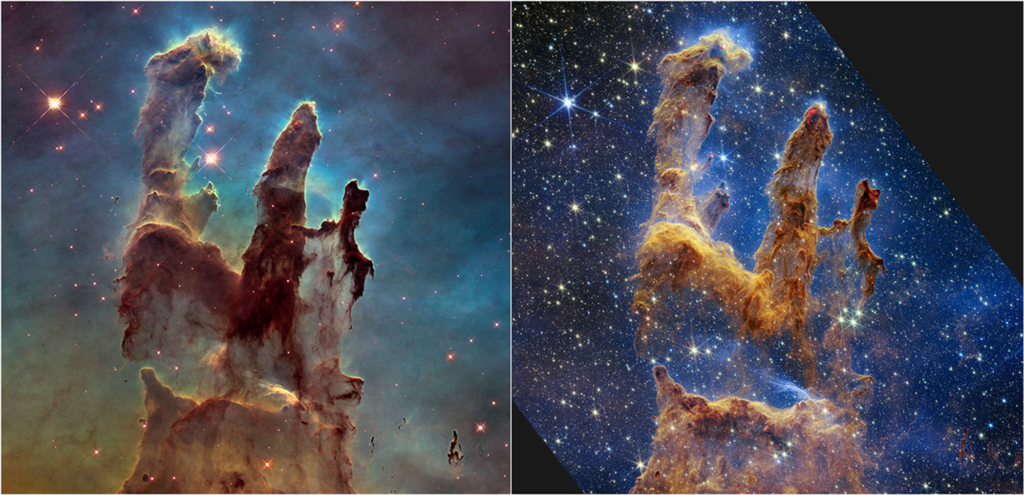
To understand Webb’s breakthrough, we first have to understand Hubble’s limitations. Hubble observes the universe primarily in visible light—the same spectrum of light that human eyes can detect.
When Hubble captured its iconic images of the pillars (first in 1995, and again with an upgraded camera in 2014), it delivered a breathtaking but heavily obscured view.
Hubble gave us the shape of creation. But the actual process of creation remained hidden in the dark.
This is where the James Webb Space Telescope changes the game. Webb is designed to see the universe in near-infrared and mid-infrared light.
Unlike visible light, which scatters and bounces off thick clouds of cosmic dust, infrared wavelengths are longer. This allows them to easily glide through the dust, penetrating the dense interstellar medium. When Webb aimed its Near-Infrared Camera (NIRCam) at the pillars, the impenetrable brown towers suddenly became diaphanous, ghostly, and semi-transparent.
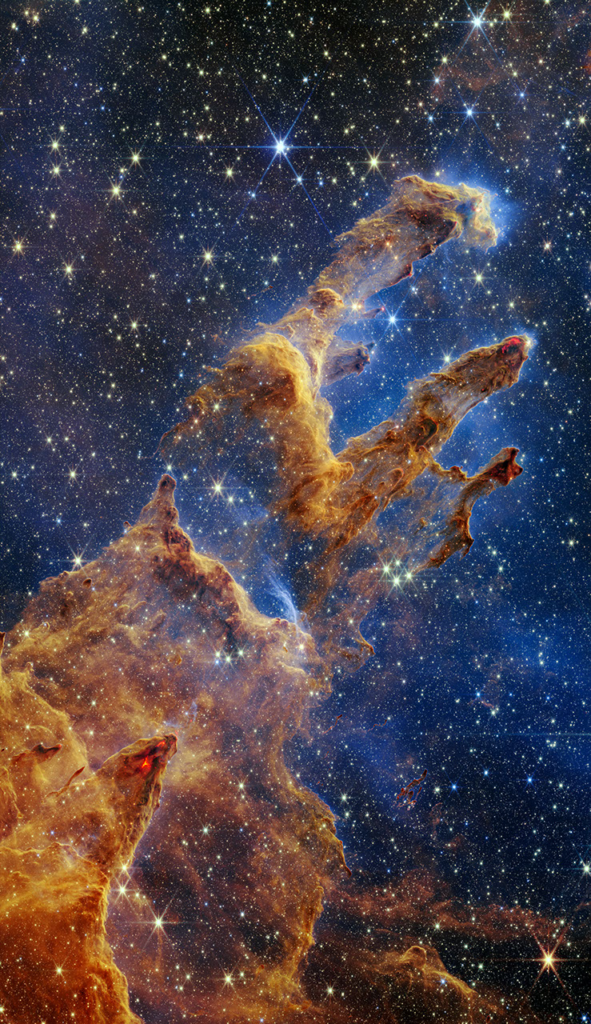
When you look at the Webb image, three major scientific discoveries immediately jump out:
Look closely at the edges of the semi-transparent pillars in the Webb image. You will see hundreds of bright, glowing red orbs. These are protostars—infant stars that are still gathering mass. When knots of gas and dust inside the pillars become massive enough, they collapse under their own gravity, heat up, and eventually ignite. Webb’s infrared sensors detect the thermal glow of these young stars, exposing a population that Hubble’s visible-light cameras could never register.
Along the edges of the pillars, Webb captured wavy, glowing crimson lines that look almost like flowing lava. These are the violent byproducts of star formation. As young stars coalesce, they periodically eject high-energy supersonic jets of material into space. When these jets crash into the thick surrounding clouds of molecular hydrogen, they create massive ripples, or “bow shocks,” similar to a boat carving through water. These ejections are estimated to be only a few hundred thousand years old.
You might expect Webb’s incredibly powerful sensors to peer straight through the nebula and capture thousands of distant background galaxies. Surprisingly, there are almost no galaxies visible in the background of this image.
Why? Because the interstellar medium in the most dense part of the Milky Way acts like a drawn curtain. The sheer volume of translucent gas blocks our view of the deeper, distant universe. Instead, the dust is illuminated by the collective light of the packed “party” of newly born stars, creating a glowing blue background.
We do not use the James Webb Space Telescope to replace Hubble; we use them together to get a complete, multi-wavelength understanding of the universe.
Hubble shows us the dense, cold layers of dust and the physical structure of the nebula. Webb pierces through that dust to show us the thermal heat of the infant stars embedded inside.
By combining these two perspectives, astrophysicists can drastically revamp our models of star formation. By identifying far more precise stellar populations and mapping the exact quantities of gas and dust, we gain a clearer, more accurate understanding of how stars burst out of these clouds over millions of years.
The Pillars of Creation aren’t just a beautiful landmark – thanks to Webb, they are now one of the most detailed laboratories we have for understanding our cosmic origins.