Physical Address
304 North Cardinal St.
Dorchester Center, MA 02124
Physical Address
304 North Cardinal St.
Dorchester Center, MA 02124

 BySandy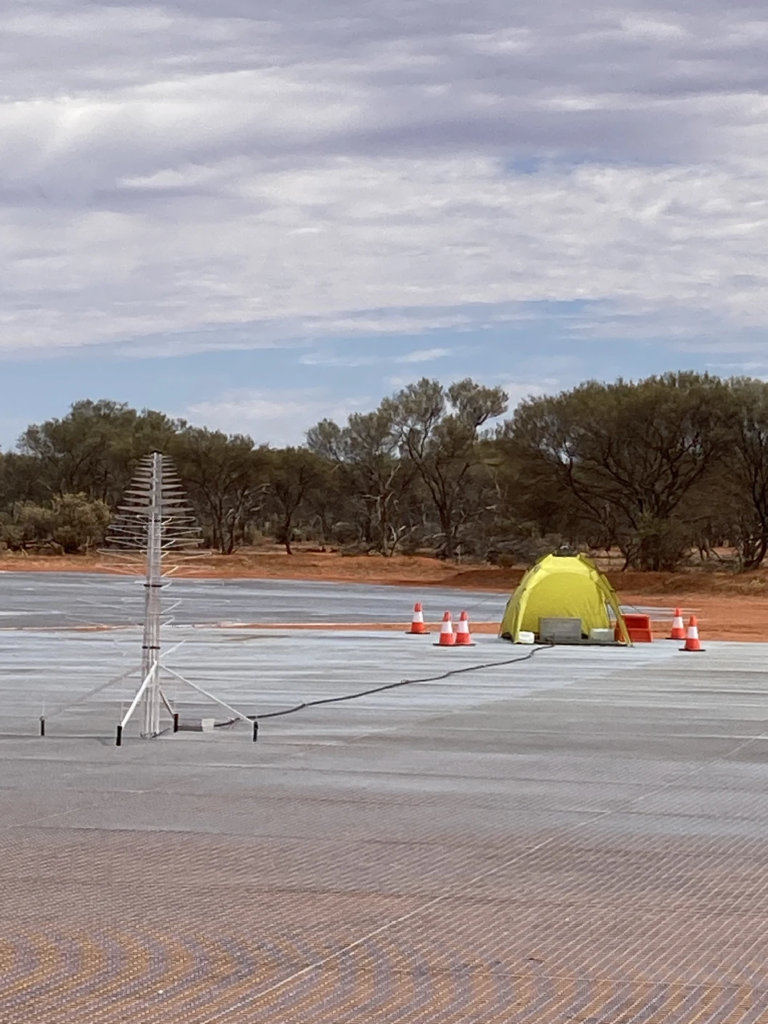
A team led by CSIRO has measured the low-frequency radio sky as significantly brighter than the standard reference model used across radio astronomy. Observations taken at Inyarrimanha Ilgari Bundara, the CSIRO Murchison Radio-astronomy Observatory in Western Australia show that sky brightness between 60 and 350 megahertz (MHz) runs 20% to 50% higher than the 2016 Global Sky Model (GSM2016) predicts. The results, published in Nature Astronomy, mean low-frequency radio telescopes have been calibrating against a foreground dimmer than the one that actually exists.
Most radio calibration relies on pointing a telescope at a bright, well-characterized object — the Moon, a planet, or a discrete radio source — and using its known brightness to set the scale. “At higher radio frequencies, calibration is much easier,” Michiel Brentjens, a radio astronomer at ASTRON, the Netherlands Institute for Radio Astronomy who was not involved in the study, told Sky & Telescope, since below a few hundred megahertz the diffuse Galactic background itself dominates the signal.
The CSIRO team, led by Luke McKay, avoided the problem by building a receiver that calibrates itself against the diffuse sky rather than a discrete source. The instrument, designed at CSIRO and covered by Australian patent application AU2025901969 filed May 21, 2025, is named GINAN — “Global Imprints from Nascent Atoms to Now” — after the name the Wardaman people of northern Australia give to the fifth-brightest star of the Southern Cross. It was paired with a single SKALA4.1 log-periodic antenna — the same antenna design built for the SKA-Low telescope — mounted at the center of a 40-meter-diameter ground mesh.
GSM2016, the reference most radio astronomers use to predict sky brightness at a given frequency and position, is built from all-sky radio surveys observed between 1965 and 1999. The primary absolute flux calibration measurements underlying those surveys were all made in the 1960s, using three discrete sources — Cassiopeia A, Cygnus A, and Taurus A — in what became known as the Baars flux scale. That chain has anchored most long-wavelength radio astronomy calibration for roughly fifty years.
By measuring the diffuse background directly with a self-calibrating receiver, McKay’s team sidestepped that decades-old calibration chain entirely. Their result indicates GSM2016 itself was built on too dim a baseline.
The team observed for roughly eight hours on October 23, 2024, from 10:05:40 to 18:00:06 UTC, sweeping across 60 to 350 MHz. Key findings:
Radio astronomers trying to detect the faint 21-centimeter signal from the Epoch of Reionization and Cosmic Dawn — radiation from the first hydrogen gas illuminated by the universe’s earliest stars and galaxies — must subtract this same Galactic and extragalactic foreground with extreme precision, since the cosmological signal they’re searching for is many times fainter than the foreground itself. A foreground model that is systematically too dim, as GSM2016 now appears to be, would bias that subtraction.
The team’s revised excess background measurement also reopens questions about the population of faint, unresolved extragalactic radio sources that contribute to it, and — more speculatively — about decaying or annihilating dark matter as a partial source of the excess. The authors caution that this interpretation depends on simplified models of the Galaxy’s own emission and is not a firm conclusion of the paper.
McKay’s team proposes that their self-calibration method, rather than the decades-old discrete-source flux scale, could itself become the new absolute calibration standard for SKA-Low and other next-generation low-frequency telescopes.
The result replaces a calibration chain that has gone largely unchanged since the 1960s with one based on direct measurement of the sky itself — a foundation future Cosmic Dawn and Epoch of Reionization experiments will depend on to separate a faint cosmological signal from the brighter universe in front of it.
SOURCE ATTRIBUTION
Source: CSIRO — Space and Astronomy
Published in: Nature Astronomy
Primary source: https://www.nature.com/articles/s41550-026-02888-5
Based on reporting by Govert Schilling, Sky & Telescope: https://skyandtelescope.org/astronomy-news/radio-astronomers-measure-a-brighter-sky-than-they-expected/