Physical Address
304 North Cardinal St.
Dorchester Center, MA 02124
Physical Address
304 North Cardinal St.
Dorchester Center, MA 02124

 BySandy
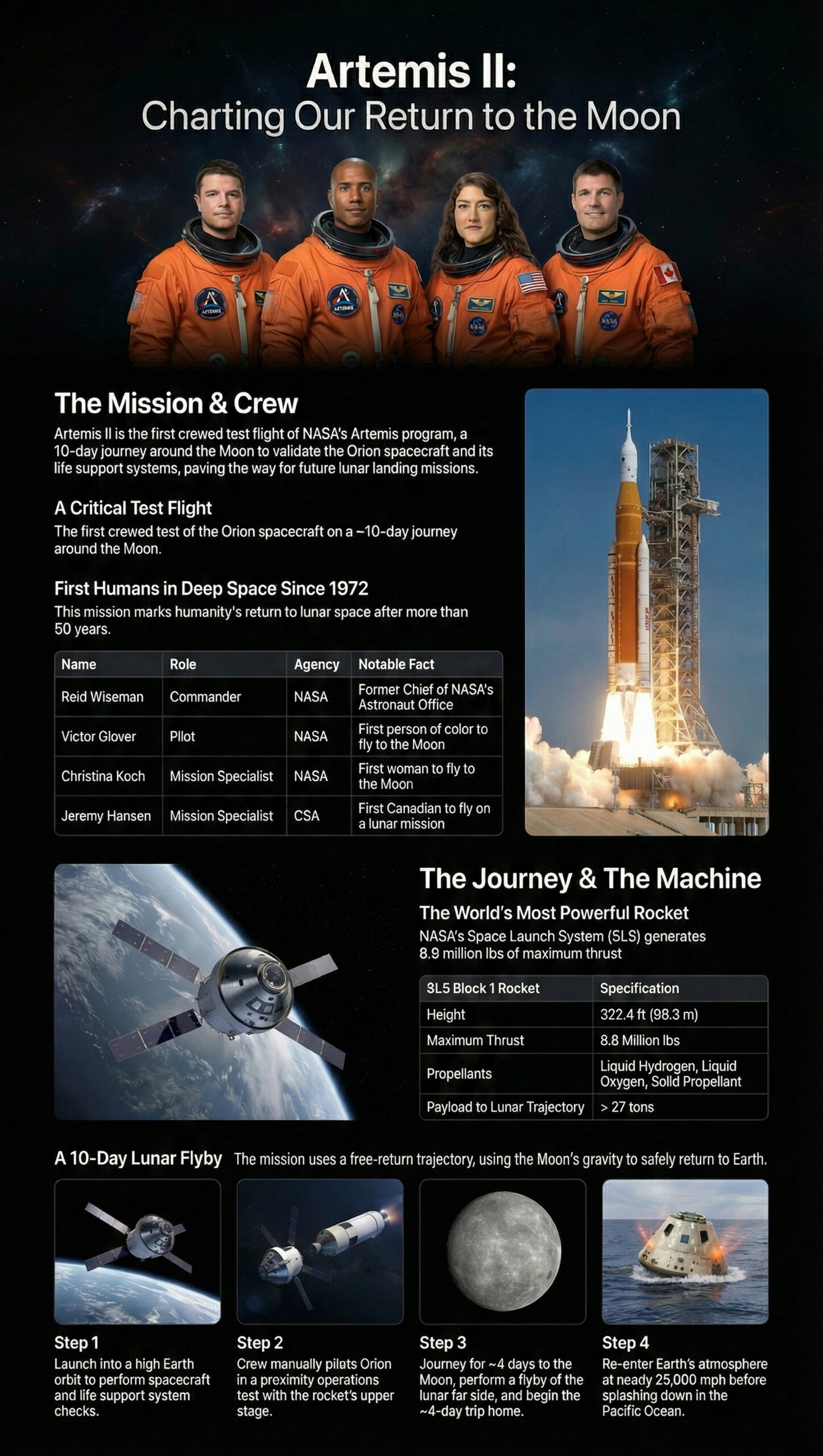
In 2026, humanity will return to lunar space with NASA’s Artemis 2 mission, the first crewed journey beyond low Earth orbit since Apollo 17 in 1972. The ten-day flight will send four astronauts aboard the Orion spacecraft on a free-return trajectory around the Moon, validating systems needed for sustained human exploration. This mission matters because it restores a deep-space human capability, tests critical technologies, and sets the stage for future lunar landings. A key highlight to watch is the mission’s unique figure-eight path around the Moon—designed to ensure a safe return while pushing human spaceflight farther than any crewed mission in decades.
The Artemis 2 crewed lunar mission marks the United States’ first human voyage to lunar space in more than half a century. The last astronauts to orbit and walk on the Moon departed in December 1972, concluding the Apollo era. Since then, human spaceflight has remained confined to low Earth orbit, primarily aboard the International Space Station.
Artemis 2 follows the uncrewed Artemis 1 test flight launched in November 2022, which successfully demonstrated the integrated performance of NASA’s new heavy-lift rocket and crew capsule. While early schedules aimed for a 2023 crewed flight, technical findings—most notably heat-shield wear during atmospheric re-entry—shifted the timeline. The revised plan targets a launch window beginning in early 2026, reflecting a more cautious, test-driven approach.
Beyond symbolism, the Artemis 2 crewed lunar mission is a systems-validation flight. Its goal is not to land but to confirm that Orion, its life-support systems, navigation, and re-entry protection can safely carry humans to deep space and back.
The Artemis 2 crewed lunar mission will launch aboard NASA’s Space Launch System (SLS), currently the most powerful operational rocket. After reaching Earth orbit, the spacecraft’s upper stage will perform a translunar injection burn, sending Orion toward the Moon.
Instead of entering lunar orbit, Orion will follow a free-return trajectory—a carefully calculated path that loops around the Moon and naturally falls back toward Earth. This trajectory minimizes risk: even without engine burns near the Moon, gravity alone would guide the spacecraft home.
During the flight, astronauts will test Orion’s environmental control systems, communications at lunar distances, and manual flight operations. Biomedical experiments will also be conducted to measure radiation exposure, immune response, and other physiological changes experienced beyond Earth’s protective magnetosphere—data not gathered from humans since Apollo.
Recent preparations and rehearsals highlight how the Artemis 2 crewed lunar mission is progressing from concept to reality. The selected crew—Reid Wiseman (commander), Victor Glover (pilot), Christina Koch, and Canadian astronaut Jeremy Hansen—has completed years of integrated training, including spacecraft simulations and launch-day procedures.
Engineering assessments show that Orion’s redesigned heat-shield is performing as expected in ground testing, addressing concerns raised after Artemis 1. Meanwhile, SLS stacking and rollout timelines indicate readiness for launch campaigns beginning weeks before the opening window.
Collectively, these updates suggest the mission is transitioning into its final verification phase, where operational readiness—not design iteration—becomes the focus.
The Artemis 2 crewed lunar mission has implications that extend beyond human exploration. By restoring the capability to send astronauts into cislunar space, NASA enables future missions to deploy, service, and operate scientific instruments from lunar orbit and surface locations.
Strategically, Artemis 2 also underpins plans for a sustained lunar presence, including surface habitats and resource utilization near the Moon’s south pole—an area believed to host water ice critical for life support and fuel production. International competition adds urgency, as China advances its own crewed lunar architecture.
From a research standpoint, Artemis 2 provides foundational data for longer missions, including eventual crewed journeys to Mars, where radiation exposure and system reliability become mission-defining challenges.
If launched on schedule, Artemis 2 may carry its crew farther from Earth than any previous human mission, potentially surpassing the distance record set during Apollo 13. The mission is also historically significant: Christina Koch and Victor Glover will become the first woman and first person of color to travel to lunar space.
While later Artemis missions depend on lunar landers developed by commercial partners such as SpaceX and Blue Origin, Artemis 2 stands apart. Its success does not hinge on surface hardware, making it a decisive milestone regardless of future architectural changes.
Sources & Credits
• NASA Artemis Program
• NASA Human Spaceflight and Orion mission briefings
• Information summarized from publicly available research, mission updates, and observatory releases.