Physical Address
304 North Cardinal St.
Dorchester Center, MA 02124
Physical Address
304 North Cardinal St.
Dorchester Center, MA 02124

 BySandy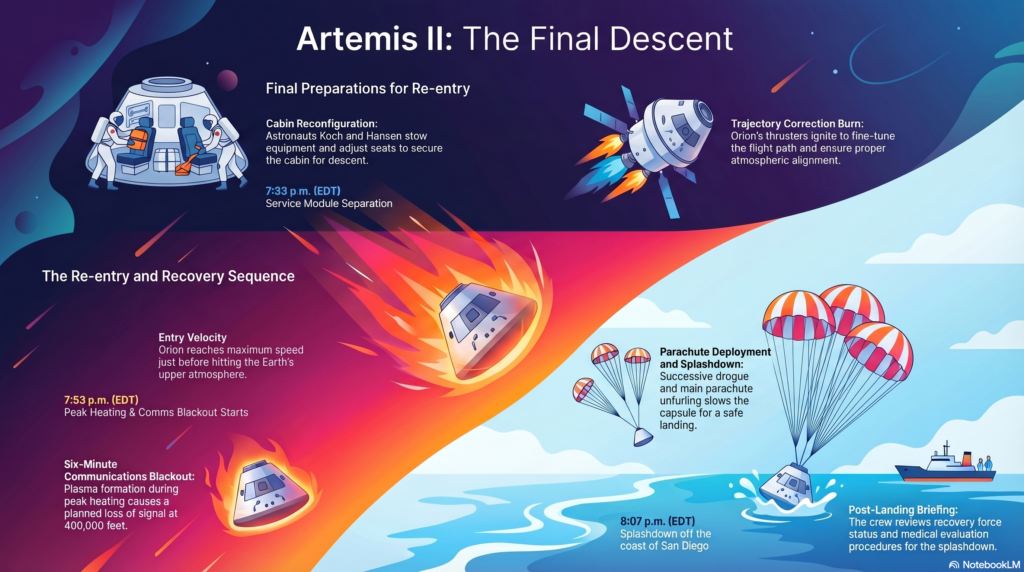
NASA’s Artemis II Earth splashdown return marks the closing phase of humanity’s first crewed lunar mission in more than 50 years, as four astronauts aboard Orion prepare to re-enter Earth’s atmosphere after a successful journey around the Moon. The mission is a defining systems test for future lunar expeditions, validating deep-space crew operations, high-speed re-entry procedures, and ocean recovery architecture. Its significance extends beyond safe return: every maneuver during descent informs the reliability of future Artemis landings. One critical highlight is Orion’s high-velocity atmospheric re-entry at nearly 24,000 miles per hour, followed by a precisely timed parachute descent into the Pacific Ocean.
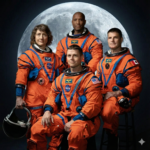
The Artemis II Earth splashdown return represents the final operational phase of NASA’s first crewed Artemis mission, concluding a ten-day journey around the Moon and back. The crew—NASA astronauts Reid Wiseman, Victor Glover, Christina Koch, and Canadian Space Agency astronaut Jeremy Hansen—has completed a historic lunar flyby aboard NASA’s Orion spacecraft, becoming the first humans to travel beyond low Earth orbit since Apollo 17 in 1972.
Unlike Apollo lunar missions, Artemis II is designed primarily as a full-system validation flight rather than a landing mission. Its objective is to test Orion’s life support, navigation, propulsion, communications, and re-entry performance under real deep-space conditions before Artemis III attempts a crewed lunar landing.
After exiting the Moon’s gravitational sphere of influence on April 7, Orion began its return arc toward Earth. The splashdown scheduled for April 10 off the coast of San Diego is the culmination of multiple precisely timed orbital corrections, atmospheric entry calculations, and recovery coordination between NASA and U.S. military teams.
The Artemis II Earth splashdown return involves one of the most technically demanding phases of any deep-space mission: controlled atmospheric re-entry from lunar velocity.
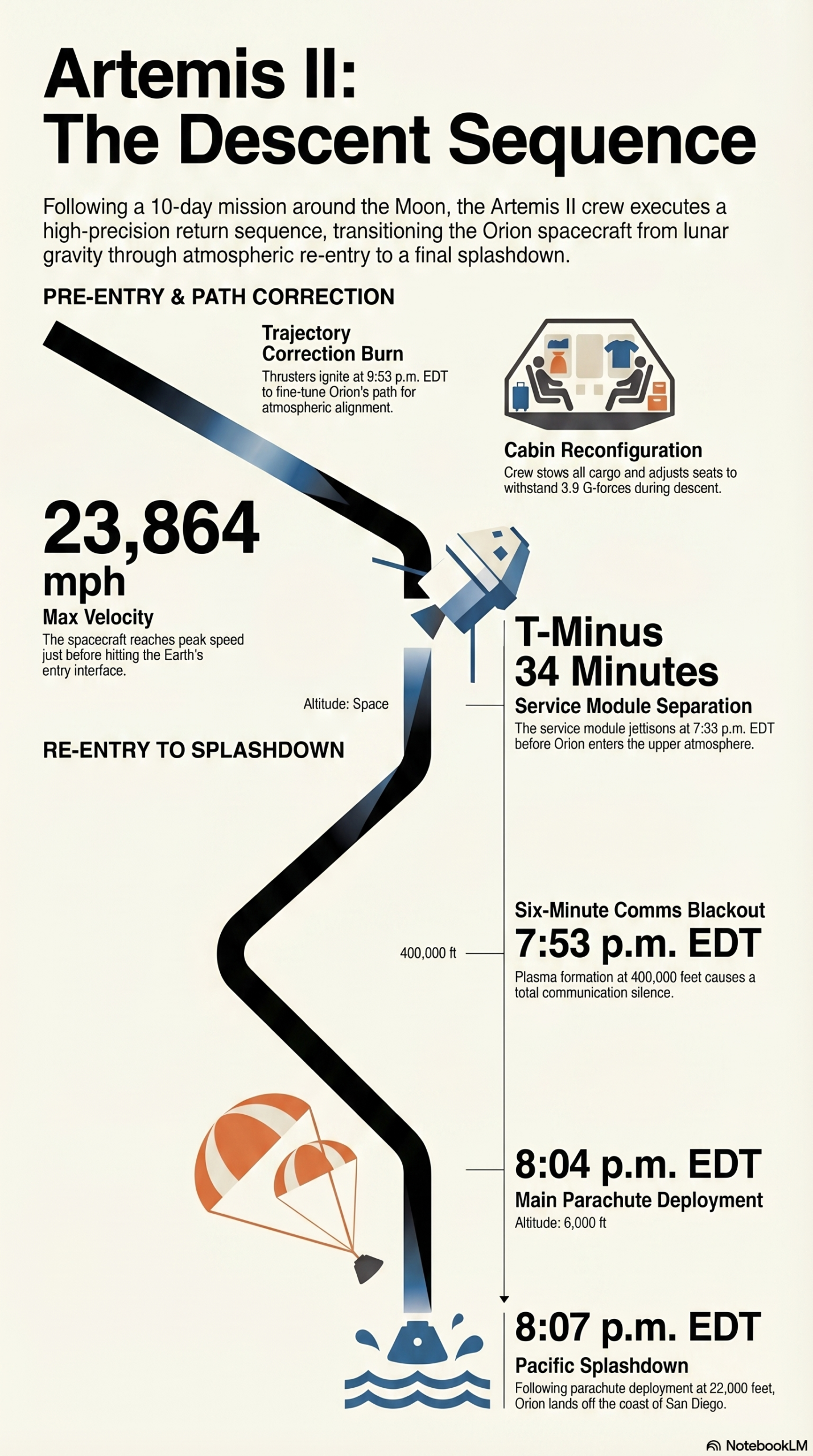
As Orion approaches Earth, its service module will separate roughly 20 minutes before atmospheric interface. This discarded module contains propulsion and power systems used during transit, leaving only the crew capsule to survive re-entry.
Shortly afterward, Orion performs a final trajectory-adjustment burn to align its descent corridor. The spacecraft then enters Earth’s upper atmosphere at approximately 23,864 mph, generating intense aerodynamic heating as compressed air ionizes into plasma around the capsule.
This plasma sheath creates a six-minute communications blackout beginning around 400,000 feet altitude. During this phase, temperatures outside Orion rise dramatically, while the spacecraft’s heat shield absorbs and dissipates thermal energy.
The capsule’s descent sequence unfolds in stages:
The crew is expected to experience up to 3.9 Gs, within safe physiological limits for trained astronauts.
NASA’s latest mission updates show Orion performing within expected trajectory margins as it nears Earth. The second return trajectory correction burn, executed on April 9, fine-tunes the spacecraft’s alignment for precise atmospheric entry.
These adjustments reveal the importance of mid-course navigation accuracy in lunar-return missions. Even minor trajectory deviations can significantly alter re-entry angle, potentially risking overheating or unstable descent.
Operationally, Artemis II has also demonstrated the effectiveness of crew-led spacecraft monitoring. Jeremy Hansen’s role in supervising guidance and propulsion checks during correction burns highlights Orion’s hybrid architecture: automated precision combined with human oversight.
Equally important is the synchronized readiness of recovery systems. Helicopter Sea Combat Squadron aircraft, naval recovery vessels, and extraction teams positioned aboard USS John P. Murtha form part of a tightly choreographed retrieval network designed to recover astronauts within hours of landing.
The Artemis II Earth splashdown return is more than mission closure—it is a certification milestone for the Artemis program’s future.
Successful re-entry validates Orion as a deep-space crew transport vehicle capable of repeated lunar missions. This is essential for Artemis III and later expeditions involving lunar orbit docking, south polar landings, and long-duration surface habitation.
Scientifically, biomedical data collected during re-entry will improve understanding of how astronauts respond to deep-space radiation exposure, gravitational transitions, and re-entry stress after extended lunar-distance travel.
Future missions will build directly on Artemis II findings, refining:
These lessons are also relevant for Mars mission planning, where Earth return velocities may be even higher and atmospheric entry margins narrower.
A notable engineering feature in Artemis II is Orion’s lofted entry profile, a modern re-entry technique that briefly uses atmospheric lift to reduce speed before final descent. Unlike Apollo capsules, which followed simpler ballistic returns, Orion can actively shape its re-entry path for improved thermal control and landing precision.
Historically, this mission revives a capability absent since the Apollo era: safe human return from lunar distances. While Apollo pioneered lunar re-entry, Artemis modernizes it with advanced guidance software, composite materials, and digital telemetry systems.
The mission also marks historic milestones for representation in human spaceflight: Christina Koch becomes the first woman to complete a crewed lunar flyby, and Victor Glover becomes the first Black astronaut to travel to lunar space.
Sources & Credits
• NASA Artemis II Mission Operations Team
• NASA Johnson Space Center
• Orion Multi-Purpose Crew Vehicle Program
• Canadian Space Agency Artemis II Crew Office
• Original NASA mission update: NASA Artemis Blog, April 9, 2026
• Information summarized from publicly available research, mission updates, and observatory releases.