Physical Address
304 North Cardinal St.
Dorchester Center, MA 02124
Physical Address
304 North Cardinal St.
Dorchester Center, MA 02124

 BySandy
A new peer-reviewed study published in Nature warns that rapidly expanding satellite megaconstellations pose a major and escalating threat—not just to ground-based observatories, but to space telescopes in Low Earth Orbit (LEO).
Reflections from satellites already show up as bright streaks across astronomical exposures, and the contamination is increasing far faster than previously predicted.
Today’s ~15,000 satellites represent less than 3% of what companies have proposed to launch by the mid-2030s. If current plans are realized, the authors forecast that:
The study concludes that space telescopes are not immune and will face substantial operational challenges as LEO becomes increasingly crowded.
Satellite trails form when sunlight reflects off a passing spacecraft during a telescope exposure. Even in space—far from city lights—these reflections can be:
The authors simulated millions of exposures for four space telescopes:
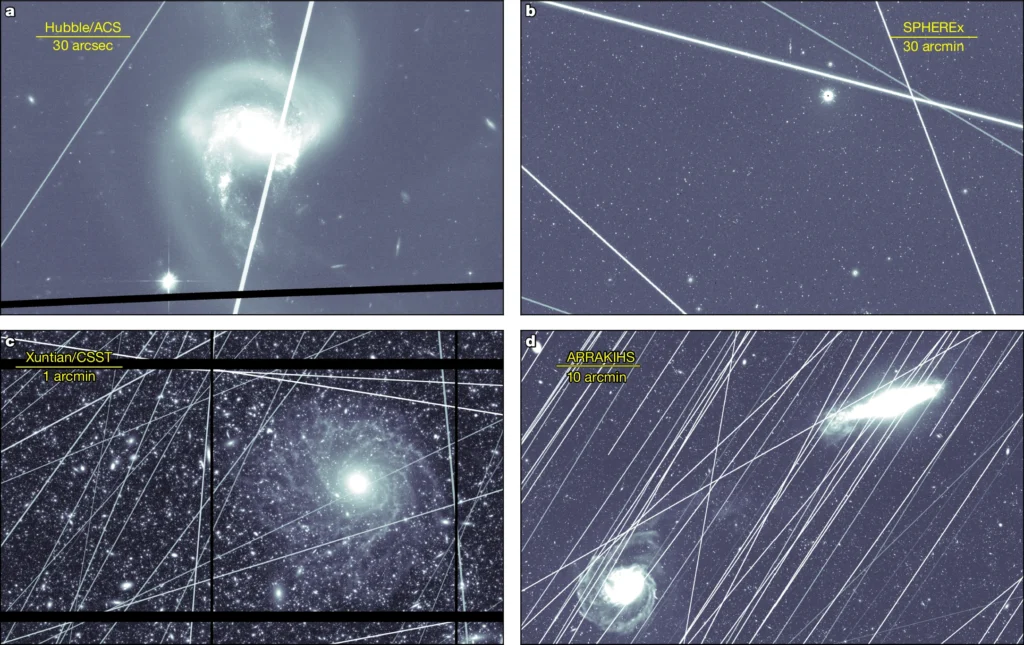
As satellite numbers rise into the hundreds of thousands, each telescope’s exposure becomes increasingly likely to be crossed by bright, Sun-illuminated trails.
Simulated satellite trails typically reach:
These values are well within the detection limits of modern imaging sensors.
For reference, a confirmed Starlink trail observed by Hubble in 2020 measured 18.0 mag/arcsec²—matching the new predictions almost exactly.
The explosion of megaconstellation proposals—driven by cheaper launches and large platforms like Starship—means LEO could hold over half a million satellites by the 2030s.
Many satellites operate at altitudes between 500–800 km, overlapping with the orbits of major space telescopes. As a result:
The authors note that mitigation techniques used on newer satellites—dark coatings, visor shields, attitude changes—reduce visibility to the naked eye, but do not reduce brightness to levels tolerable for professional observatories.
Some newer “Direct-to-Cell” satellites are much brighter, approaching magnitudes 0–1, rivaling the brightest stars.
If planned constellations reach ~560,000 active satellites:
At one million satellites, contamination becomes extreme:
Space telescopes designed for faint-galaxy surveys, reionization studies, and mapping the cosmic infrared background will see major quality degradation.
Unlike ground-based observatories, space telescopes:
Some newly launched satellites have 125 m² solar panels, dramatically increasing their reflective cross-section.
Even non-operational satellites that tumble unpredictably can become extremely bright and difficult to model.
The authors highlight several actions needed to keep space telescopes viable:
The paper warns that current orbit formats (e.g., TLEs) are accurate only to ~1 km, far too imprecise for scientific avoidance.
The study concludes that without coordinated global action, satellite megaconstellations will significantly degrade the scientific return of both current and future space telescopes.
Upcoming missions such as SPHEREx, Xuntian, and ARRAKIHS will face the highest risk, while even longstanding observatories like Hubble will see rapidly rising contamination levels.
The authors compare today’s situation to early warnings about ozone depletion in the 1970s—signals that were recognized only after damage had begun.
As the number of satellites grows by one to two orders of magnitude, protecting the dark and quiet sky—even in orbit—has become a scientific, engineering, and policy challenge for the decade ahead.
Original Study: Borlaff, A. S., Marcum, P. M., & Howell, S. B. Satellite megaconstellations will threaten space-based astronomy. Nature 648, 51–57 (2025).