Overview: A Big Month for Skywatchers
December 2025 brings three major celestial events:
- Comet 3I/ATLAS makes its closest approach to Earth
- The Geminid meteor shower reaches peak activity
- The Moon and Jupiter align in a bright conjunction
These events offer some of the best opportunities of the year for backyard observers and telescope users alike.
Comet 3I/ATLAS Makes Its Closest Approach — Dec 19
Comet 3I/ATLAS—only the third confirmed interstellar object ever discovered in our solar system—reaches its closest point to Earth on December 19.
Although it poses no threat and will remain over 170 million miles away, skilled observers may still catch a glimpse.
How to See It
- Look east to northeast in the pre-dawn hours
- The comet sits just below Regulus, the heart of the constellation Leo
- Visibility requires a telescope with a 30 cm (12-inch) aperture or larger
- Check local observatories or astronomy clubs for viewing events
NASA continues to study this rare visitor using multiple telescopes and spacecraft to understand its composition and origin.
Geminid Meteor Shower Peaks — Dec 13–14
The Geminids, one of the most reliable and colorful meteor showers of the year, reach their peak on December 13–14.
What to Expect
- Up to 120 meteors per hour under dark skies
- Bright, multicolored streaks caused by debris from the asteroid 3200 Phaethon
- Meteors radiate from the region near Jupiter, between Betelgeuse and Procyon
How to Watch
- Look east starting around 10 PM
- No telescope required—just find the darkest sky you can
Moon–Jupiter Conjunction — Dec 7
On the night of December 7, the Moon and Jupiter appear unusually close in the eastern sky, forming a striking conjunction.
Where to Look
- Around 11 PM, glance eastward
- Jupiter will sit just above and to the right of the Moon
- Although they appear close together, the two bodies are hundreds of millions of miles apart
This is an easy event for all observers—no telescope needed.
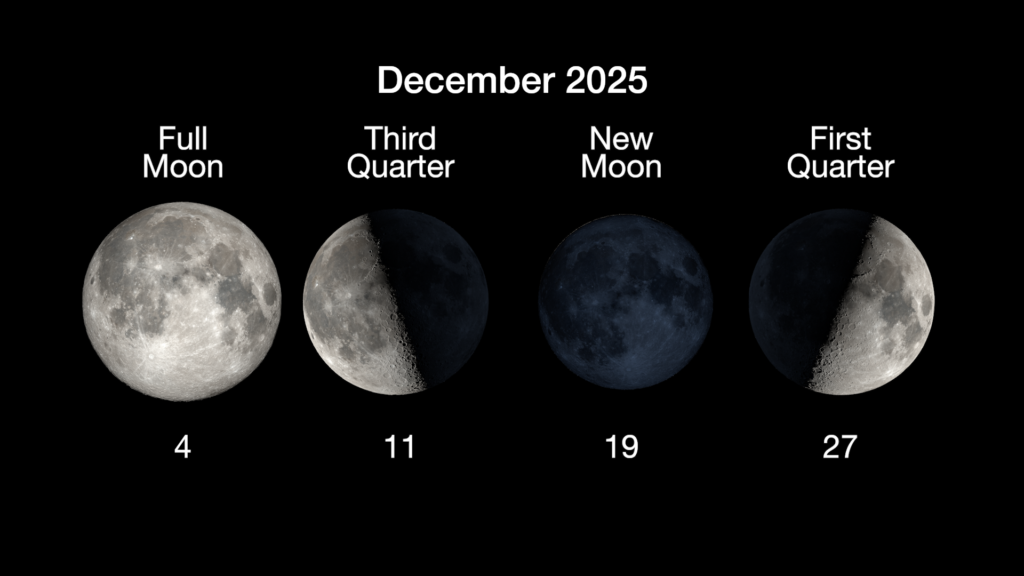
Moon Phases for December 2025
- Full Moon — December 4
- Third Quarter — December 11
- New Moon — December 19
- First Quarter — December 27

These phases can help you plan the darkest nights for comet hunting or meteor watching.
Have any thoughts?
Share your reaction or leave a quick response — we’d love to hear what you think!