Physical Address
304 North Cardinal St.
Dorchester Center, MA 02124
Physical Address
304 North Cardinal St.
Dorchester Center, MA 02124

The LUX-ZEPLIN experiment recorded one 248 keV nuclear recoil event at 2.6-sigma significance in its South Dakota xenon detector, its most compelling dark matter hint yet.
 BySandy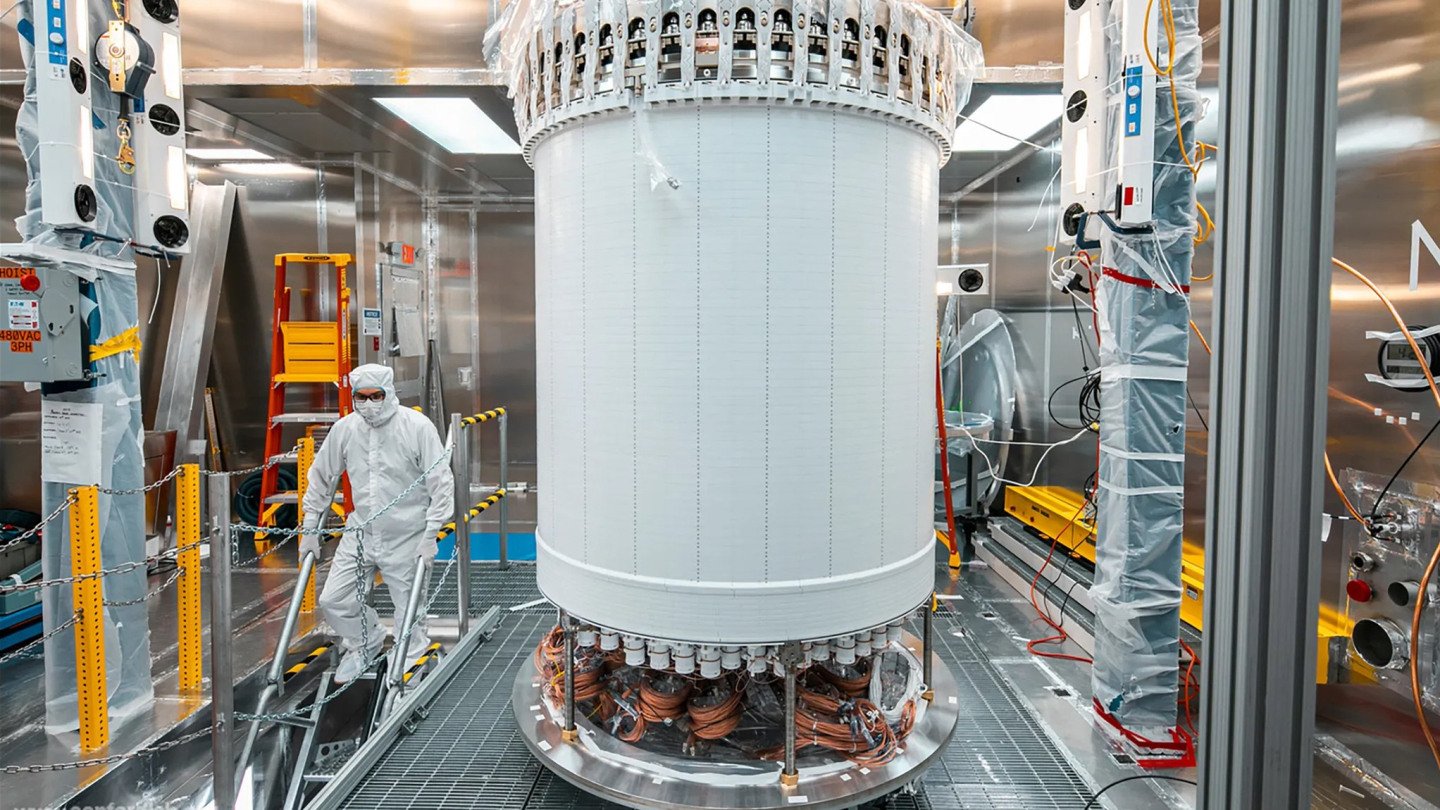
The LUX-ZEPLIN (LZ) dark matter experiment has recorded a single particle interaction that researchers cannot easily explain using known background sources, the most compelling hint of dark matter the experiment has reported since it began its search in 2021. Researchers presented the finding at the 2026 TeV Particle Astrophysics conference in Japan on September 1, 2026. The result does not meet the statistical threshold required to claim a discovery.
In a paper titled “Search for dark matter particle interactions in an extended nuclear recoil energy window with the LUX-ZEPLIN (LZ) experiment,” the LZ Collaboration reports a search using a total exposure of 2.84 tonne-years, drawn from data collected between March 2023 and April 2024. The analysis extended the detector’s nuclear recoil energy window to a range of 5.4 to 270 kilo-electronvolts (keV), broader than the window used in LZ’s earlier searches for the simplest WIMP interactions in this dataset. Within that range, the collaboration observed one event consistent with an elastic nuclear recoil of 248 ± 23 (stat) ± 23 (sys) keV, in a region where the expected background from ordinary particles is low.
A profile likelihood ratio test found the event in tension with the background-only hypothesis at a global significance of 2.6 sigma after accounting for the look-elsewhere effect, with a maximum local significance of 3.4 sigma across the models tested. Physics results are typically classified as a discovery only at 5-sigma significance. The event can be described by several theoretical models of dark matter interactions, the paper states, typically for WIMPs, or weakly interacting massive particles, with masses above 200 GeV/c2, more than 200 times the mass of a proton.
“We’re very intrigued to see this event in the data, in the region where we expect dark matter to show up, and the competing backgrounds are very low,” said Rick Gaitskell, a professor of physics at Brown University and the spokesperson for LZ. “With only one event, we don’t want to get ahead of ourselves. We are not claiming to have seen dark matter. But we have seen something interesting that we want to share with the scientific community for their input.”
The LZ detector is a 10-metric-ton tank of ultrapure liquid xenon equipped with sensors designed to record rare interactions between a WIMP and xenon atoms. It operates nearly one mile underground at the Sanford Underground Research Facility (SURF) in Lead, South Dakota, in the former Homestake gold mine, shielded from cosmic radiation by rock, a water tank, and outer detectors that guard against background neutrons. The detector is managed by the U.S. Department of Energy’s Lawrence Berkeley National Laboratory. “This was a detailed study in a region we hadn’t explored within this dataset, and we spent months of additional effort to understand all the possible causes of background events,” said Sam Eriksen, a senior research associate at the University of Bristol and lead author of the study.
“Outlier events in the data are not unexpected, but they usually stand out as a background of some kind when you look at them deeper,” said Aaron Manalaysay, a physicist at Berkeley Lab and chair of LZ’s institutional board. “This is the first example in any experiment I’ve worked on of an outlier that appears valid in every way.” JiJi Fan, an associate professor of physics at Brown not involved in the experimental research but whose theoretical work is cited in the new LZ paper, said the event could not have come from the simplest type of WIMP interaction, since that would have produced many additional lower-energy recoil events that LZ did not record. Extensions such as inelastic scattering and momentum-dependent elastic scattering could account for a single event, she said.
A paper detailing the finding is being released on the arXiv preprint repository and submitted to the journal Physical Review Letters. Gaitskell is scheduled to present the findings at a Brown University physics department colloquium on September 11. The LZ collaboration includes roughly 250 scientists and engineers from 39 institutions and has already assembled the world’s largest dark matter dataset; it will continue collecting WIMP-search data at SURF to test whether the new signal grows in significance or fades with more exposure.
Dark matter is thought to make up roughly 85% of the mass in the universe, inferred from its gravitational effects on galaxies but never directly detected. A single anomalous event is not proof of that particle, and LZ’s own researchers were careful to frame it as a data point rather than a breakthrough. But for a search that has run for decades without a confirmed detection, an outlier that survives months of scrutiny gives both direct-detection experiments like LZ and collider-based searches elsewhere a specific signal to chase.
Source: Lawrence Berkeley National Laboratory / Brown University, Department of Physics (LZ Collaboration). Published in: submitted to Physical Review Letters. Primary source: LZ Collaboration preprint and Brown University news release.
Further reading on OrbitGeo: What Is Dark Matter and Why Haven’t We Found It? | Inside the Sanford Underground Research Facility