Physical Address
304 North Cardinal St.
Dorchester Center, MA 02124
Physical Address
304 North Cardinal St.
Dorchester Center, MA 02124

NASA's Nancy Grace Roman Space Telescope launched Aug. 30 aboard a Falcon Heavy rocket, beginning a three month journey toward a vantage point one million miles from Earth.
 BySandy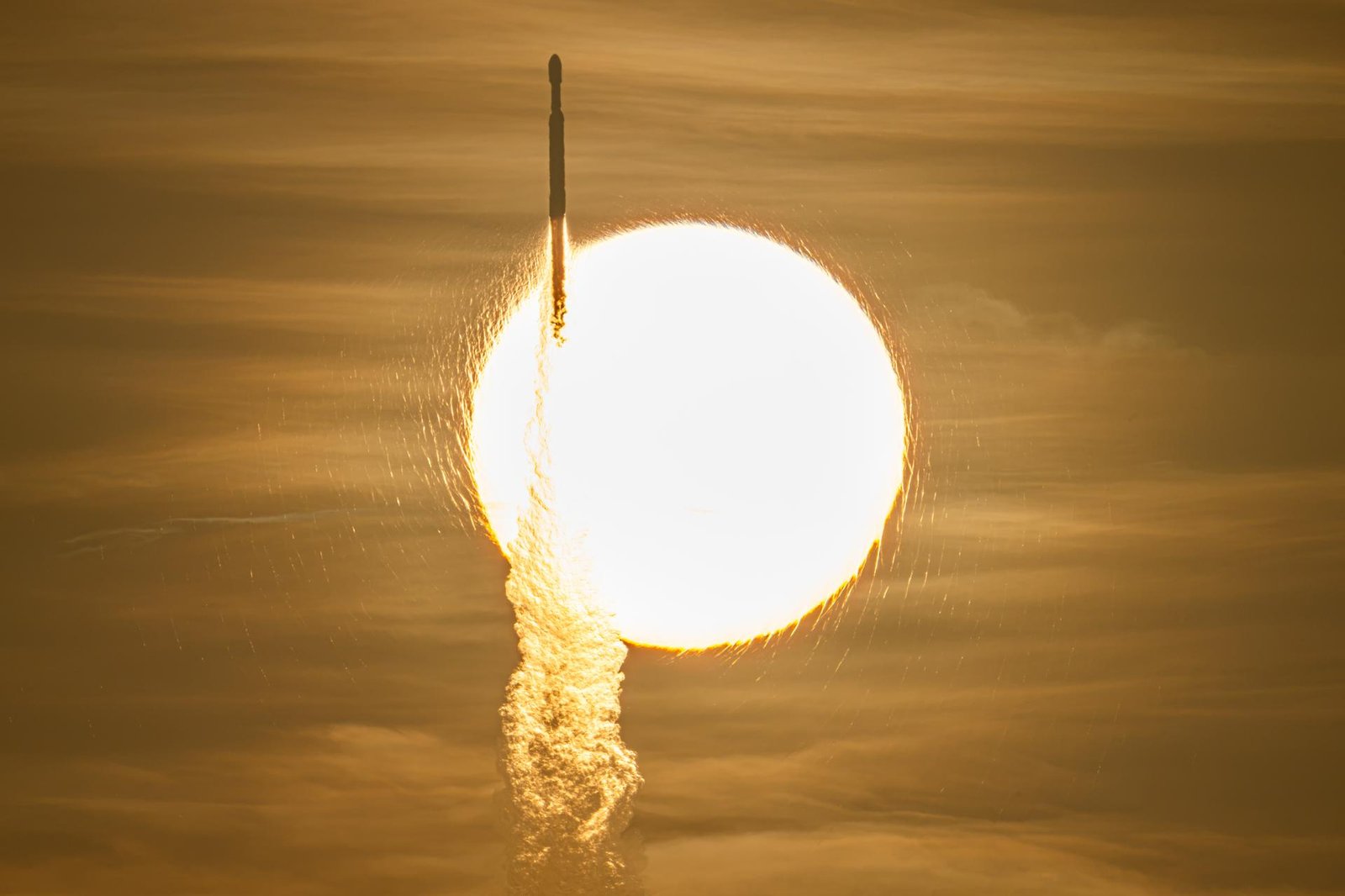
NASA’s Nancy Grace Roman Space Telescope launched at 7:26 a.m. EDT on Sunday, Aug. 30, aboard a SpaceX Falcon Heavy rocket from Launch Complex 39A at NASA’s Kennedy Space Center in Florida. The observatory is now on a three month, million mile journey to the second Sun-Earth Lagrange point, or L2, where it will begin surveying the universe for signs of dark matter, dark energy, and planets beyond our solar system.
Ground controllers at NASA’s Goddard Space Flight Center in Greenbelt, Maryland, received the first telemetry from Roman seven minutes after launch. The Falcon Heavy’s center core separated from the observatory 31 minutes into the flight, and the rocket’s side boosters returned to the launch site for refurbishment.
Roman pairs a field of view far larger than that of the Hubble Space Telescope with sharp infrared vision, letting it scan vast swaths of sky far faster than any prior NASA astrophysics mission. NASA states the telescope is designed to survey the universe a thousand times faster than Hubble. Its primary instrument, the Wide Field Instrument, is a 300-megapixel infrared camera built from 18 detectors, each about the size of a saltine cracker, that collect photons of light for conversion into wide cosmic panoramas.
That instrument will not power on immediately. NASA says the Wide Field Instrument activates a few weeks into Roman’s voyage, after ground teams verify the spacecraft’s health during early operations.
The observatory’s solar panels and lower instrument sun shade deployed successfully one hour and 23 minutes after launch, according to NASA. In the days that follow, Roman’s high-gain antenna and its visor-like deployable aperture cover are scheduled to unfold, and ground controllers will execute the first of two planned mid-course corrections. The mission’s Coronagraph Instrument, a technology demonstration built to block starlight so faint orbiting planets become visible, is also set to power on during this phase and will attempt to photograph Jupiter-like planets.
During launch and early orbit, Roman relied on the Near Space Network’s ground stations and relay satellites to exchange tracking and command data with controllers. About 70 minutes after launch, the Deep Space Network took over communications, guiding Roman toward L2 through a handoff between complexes in Canberra, Australia; Madrid, Spain; and Goldstone, California, that keeps the observatory in continuous contact with Earth.
Once fully operational, Roman will transmit 1.4 terabytes of data every day, the highest data rate of any NASA astrophysics mission to date, NASA says. Machine learning tools, artificial intelligence systems, and citizen scientists will help sort through that volume and flag findings for astronomers to study in detail.
NASA anticipates releasing Roman’s first images by early 2027, following a three month commissioning period during which scientists will calibrate and test each instrument.
Roman is the fourth primary NASA mission to launch on a Falcon Heavy rocket. Earlier in 2026, the agency’s Launch Services Program worked with SpaceX to move up the launch date after the telescope was completed ahead of schedule.
“Roman is exactly the kind of success story we want to see across NASA,” said NASA Administrator Jared Isaacman. “Delivered ahead of schedule and on budget, this mission reflects more than a decade of dedication from the NASA workforce and our industry partners.”
Nicky Fox, associate administrator for the Science Mission Directorate at NASA Headquarters, said Roman’s combination of a wide field of view and rapid survey speed will “usher us into a new era of discovery.” Julie McEnery, the mission’s senior project scientist at NASA Goddard, said the telescope offers a view of the universe unlike any available before now.
The telescope is managed at NASA Goddard, with participation from the agency’s Jet Propulsion Laboratory in Southern California, Caltech/IPAC in Pasadena, the Space Telescope Science Institute in Baltimore, and researchers from institutions across the country. BAE Systems, L3Harris Technologies, and Teledyne Scientific & Imaging serve as the primary industrial partners. International contributions come from ESA (European Space Agency), the Japan Aerospace Exploration Agency, the French space agency CNES, and the Max Planck Institute for Astronomy in Germany.
Roman’s science goals extend well beyond its three headline targets. Because its surveys will cover such wide areas of sky in such fine detail, astronomers expect the resulting data to support research on subjects the mission was not originally designed to address, from the structure of the Milky Way to the population of small bodies in the outer solar system. That breadth, combined with the sheer volume of data Roman will generate, is likely to keep researchers occupied with new results for years after the observatory reaches its final orbit.
Source: NASA Headquarters, Washington. Primary source: https://www.nasa.gov/news-release/nasas-dark-universe-seeking-nancy-grace-roman-space-telescope-launches/.