Physical Address
304 North Cardinal St.
Dorchester Center, MA 02124
Physical Address
304 North Cardinal St.
Dorchester Center, MA 02124

 BySandy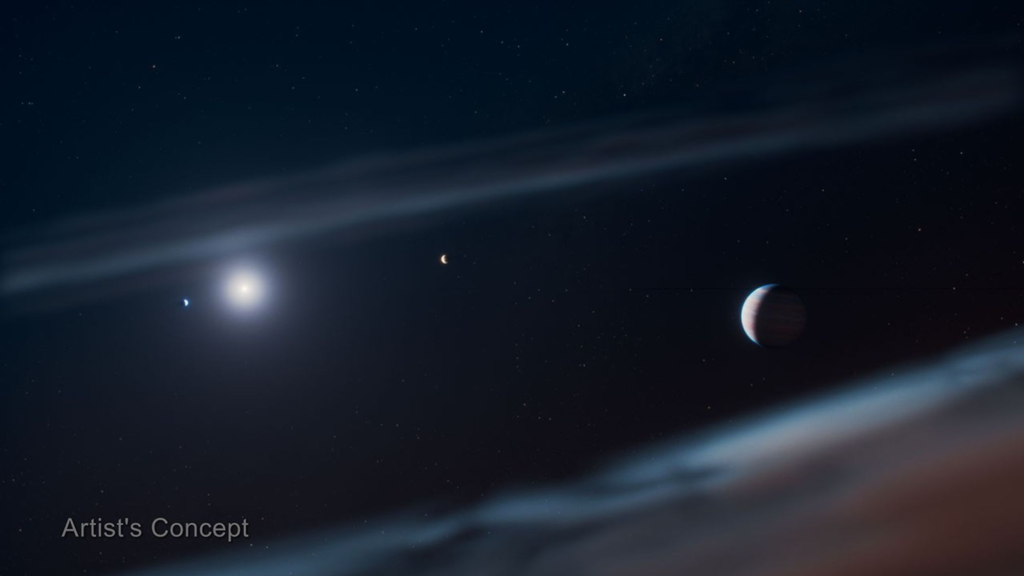
NASA’s James Webb Space Telescope has identified a third giant planet in the Beta Pictoris system, one of the most closely studied planetary systems in the galaxy. Designated Beta Pictoris d, the exoplanet is at least twice the mass of Jupiter and orbits at roughly 30 astronomical units — comparable to Neptune’s distance from the Sun in our own solar system.
Beta Pictoris lies 63 light-years from Earth and is about 23 million years old, young enough that astronomers can still watch planets interact with the disk of dust and debris left over from their formation. The system was already known to host two giant planets: Beta Pictoris b, one of the first exoplanets ever directly imaged, and Beta Pictoris c.
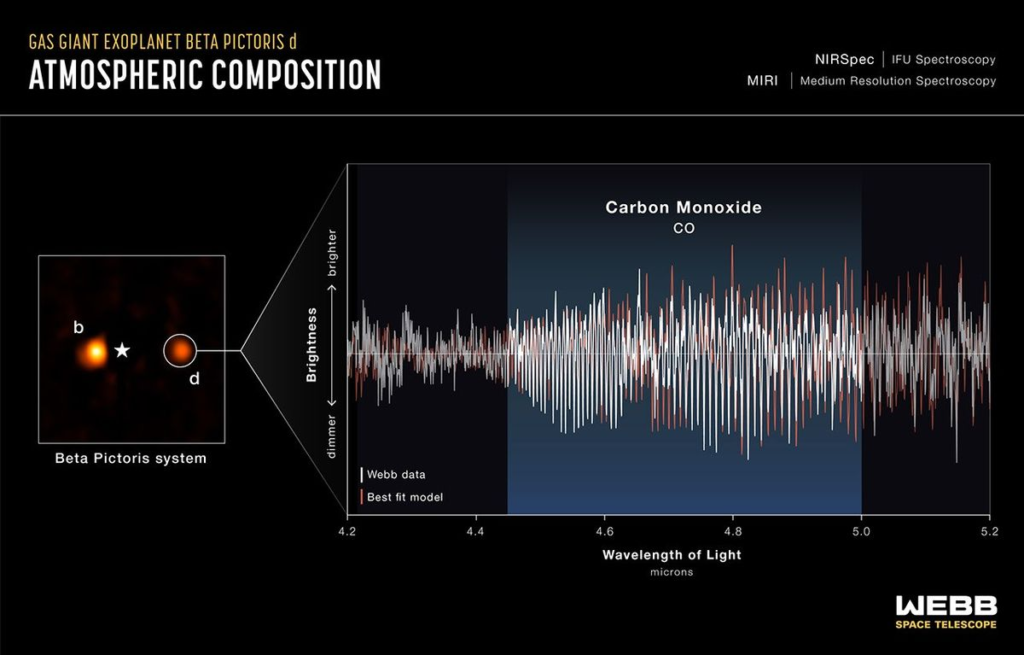
The newly identified Beta Pictoris d makes this only the second known planetary system with at least three directly imaged planets. It is the smallest of the three and has the widest orbit, though it still sits inside the inner edge of the system’s debris disk.
“This discovery adds another piece to an already fascinating planetary system,” said Aidan Gibbs, lead author of the discovery paper and a postdoctoral researcher at the University of California, San Diego. “Beta Pictoris has long served as a laboratory for understanding how planetary systems form and evolve.”
The team was not searching for a new world. They were using Webb’s NIRSpec (Near-Infrared Spectrograph) Integral Field Unit — an instrument that captures both an image and a spectrum from every pixel — to study the atmosphere of the already-known Beta Pictoris b.
“We weren’t looking for a new planet,” Gibbs said. “We were trying to understand one we already knew existed. Then, this telltale signal appeared in the data where we didn’t expect it.” That signal was a distinctive pattern of carbon monoxide absorption lines, spread across the spectrum like a barcode, where the team had expected only smooth light scattered off dust. Because spectroscopy also reveals motion, the researchers extracted the object’s radial velocity and confirmed its speed, position, and alignment matched something orbiting Beta Pictoris — not a background star or brown dwarf.
Beta Pictoris d had stayed hidden for years because it sits within one of the brightest known debris disks, where scattered starlight makes it difficult for conventional imaging to separate a planet from surrounding dust. The spectroscopic method sidesteps that problem by isolating the narrow molecular signatures unique to a planetary atmosphere rather than relying on a bright point of light.
“There was an unexpected bright source of light within the Integral Field Unit imaging, but we’ve learned not to trust bright blobs in images,” said Jean-Baptiste Ruffio, a research scientist at UC San Diego and principal investigator of the Webb observations. “A spectrum contains an incredible amount of information — you don’t just learn that something is a planet; you immediately begin learning about its temperature, chemistry, and motion.”
This marks the first directly imaged planet discovered primarily through moderate-resolution spectroscopy, rather than traditional coronagraphic imaging.
Follow-up Webb observations using the MIRI (Mid-Infrared Instrument), obtained through a Director’s Discretionary Time request, detected water vapor and methane in the planet’s atmosphere, reinforcing the identification. A separate, independent imaging study led by Ben Sutlieff of the University of Edinburgh and Markus Bonse of the European Southern Observatory used data from ESO’s Very Large Telescope alongside Webb’s NIRCam instrument and confirmed Beta Pictoris d’s existence through a different technique entirely.
Astronomers had previously predicted a planet like Beta Pictoris d might exist to explain the debris disk’s unusually sharp inner edge and other structural puzzles. Its confirmation supports that theory and gives researchers a new data point for modeling how the disk evolved.
More broadly, the discovery demonstrates that spectroscopy can reveal planets direct imaging misses entirely, particularly in dusty environments where scattered light obscures faint companions.
The team plans further observations of Beta Pictoris d to refine its temperature, atmospheric composition, and orbit. As one of astronomy’s most iconic planetary systems, Beta Pictoris continues to serve as a testing ground for the techniques astronomers will need to characterize planets around other young stars.
SOURCE ATTRIBUTION
Source: NASA — Goddard Space Flight Center / James Webb Space Telescope Mission
Published in: The Astrophysical Journal Letters (Gibbs et al., arXiv:2606.23789; companion paper Sutlieff et al., arXiv:2606.23801)
Primary source: https://science.nasa.gov/missions/webb/nasas-webb-discovers-hidden-planet-in-famous-star-system/