Physical Address
304 North Cardinal St.
Dorchester Center, MA 02124
Physical Address
304 North Cardinal St.
Dorchester Center, MA 02124

An international team led by ISTA and University of Hawaii astronomers used JWST spectra to identify MoM-BH*-1, a black hole star radiating just 660 million years after the Big Bang.
 BySandy
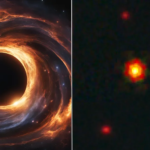
Astronomers using the James Webb Space Telescope have identified the earliest known example of a “black hole star” — a rapidly growing supermassive black hole so thoroughly wrapped in dense gas that it radiates like a single, star-like point of light. The object, catalogued as MoM-BH*-1, emitted the light now reaching Earth just 660 million years after the Big Bang, 13 billion years ago. Its spectrum exceeds the theoretical limit of any known stellar population, according to a study published August 12, 2026, in Nature.
The defining measurement is MoM-BH*-1’s Balmer break, a sharp drop in ultraviolet brightness caused by hydrogen atoms absorbing high-energy radiation. Ordinary stellar populations top out at a Balmer break of about 3; even a hypothetical population made entirely of A-type stars, which produce the deepest breaks of any stellar class, cannot exceed roughly 5. MoM-BH*-1 measured 7.7 — more than 50 percent above that theoretical stellar maximum, according to the arXiv preprint accompanying the Nature paper.
The research team, led by Rohan Naidu, an assistant professor at the University of Hawaii’s Institute for Astronomy, and Jorryt Matthee, an assistant professor at the Institute of Science and Technology Austria (ISTA), concluded the spectrum cannot originate from stars at all. “It seems a relatively inescapable conclusion that the spectrum of MoM-BH*-1 does not arise from a stellar population,” the authors wrote in their preprint.
To explain the spectrum, Naidu’s team ran close to one million simulations using the Cloudy spectral synthesis code, embedding a standard black hole accretion disk inside gas envelopes of varying density. The best match required a gas cocoon with a density of roughly 10¹¹ hydrogen atoms per cubic centimeter and a column of gas about 40 astronomical units thick — comparable to 5.9 billion kilometers — surrounding a black hole estimated at 1 million to 10 million solar masses.
At that density, the gas column becomes “Compton-thick,” opaque even to hard X-rays. Radiation from the black hole’s accretion disk is absorbed and re-emitted at longer, redder wavelengths, mimicking the light output of a stellar photosphere. “We modeled MoM-BH*-1 as a miniature supermassive black hole in the earliest phases of its evolution, enshrouded by extremely dense, turbulent gas that forms a dust-free envelope around it,” Naidu said in an ISTA statement.
MoM-BH*-1’s significance extends beyond a single object. Since 2022, JWST’s deep-field surveys have catalogued more than 341 compact, ancient sources nicknamed “little red dots,” whose central engines have been difficult to identify because their light blends with that of a surrounding host galaxy. MoM-BH*-1 has no detectable host galaxy of its own, giving researchers an unobstructed view of what a bare black hole star looks like.
When the team superimposed MoM-BH*-1’s spectrum onto that of a nearby brighter galaxy — the two objects are expected to merge within about 100 million years — the combined light closely matched the defining features of a typical little red dot. “If embedded in similar host galaxies, black hole stars like MoM-BH*-1 might well serve as the central engines of baby quasars,” Matthee said.
The gas cocoon also resolves a five-decade puzzle: how black holes weighing billions of solar masses existed when the universe was under a billion years old. Standard accretion physics caps black hole growth at the Eddington rate, the point where outgoing radiation pressure balances inward gravity. Growing at that rate alone, a black hole cannot reach a billion solar masses within 700 million years of the Big Bang.
Exceeding that limit — “super-Eddington” accretion — is normally self-defeating, because the resulting radiation pushes fuel away before it can feed further growth. A Compton-thick gas cocoon breaks that feedback loop by trapping the radiation instead of letting it escape, allowing the black hole to keep accreting matter faster than standard physics would otherwise permit.
The finding is not the final word. On August 5, 2026, a separate team from the Harvard Center for Astrophysics proposed that some little red dots could instead be living supermassive stars of roughly 100,000 solar masses, shedding gas through violent pulsations before collapsing into black holes — a model that better explains nitrogen-rich chemical signatures seen in some spectra. Naidu’s team also cautioned that black hole mass estimates for other little red dots, typically derived from the width of spectral lines, may be overestimated by orders of magnitude if resonant light scattering, rather than gas orbiting the black hole, is broadening those lines.
MoM-BH*-1 does not settle the debate over what powers the universe’s little red dots, but it gives researchers their first unobstructed look at a gas-shrouded black hole in the act of assembling itself at cosmic dawn. The result adds direct observational support to a growth mechanism — super-Eddington accretion inside a dense gas envelope — that theorists have proposed for decades without a clear example to test it against.
Source: Institute of Science and Technology Austria (ISTA), in collaboration with the University of Hawaii’s Institute for Astronomy and MIT’s Kavli Institute for Astrophysics and Space Research. Published in Nature. Primary source: nature.com/articles/s41586-026-10846-4 (institutional release: eurekalert.org/news-releases/1139484).