
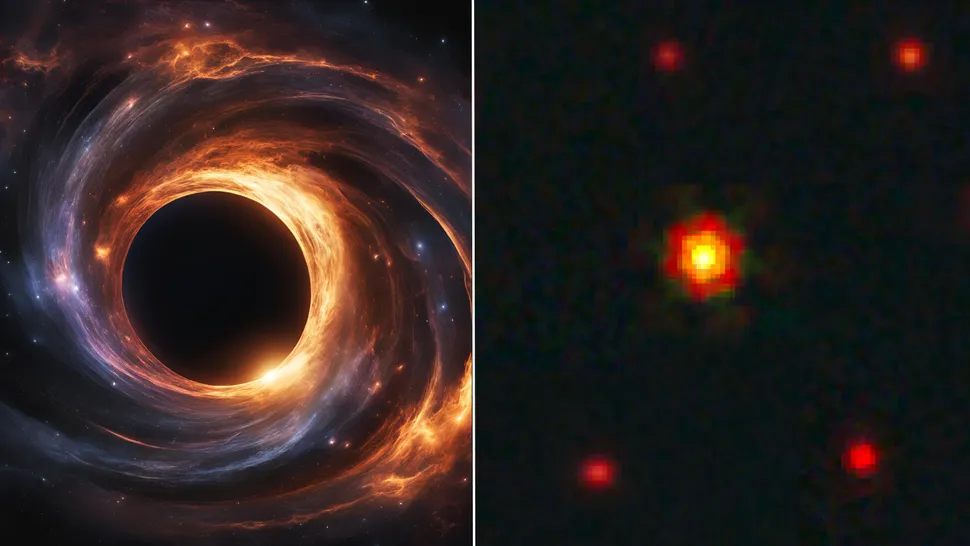
The James Webb Space Telescope has identified a rapidly growing supermassive black hole dating back to an era known as cosmic noon, roughly four billion years after the Big Bang. Nicknamed BiRD (Big Red Dot), the object belongs to a newly recognized class of compact infrared sources revealed only by Webb’s sensitivity. The finding helps explain how black holes grew so massive early in cosmic history and challenges assumptions about their visibility during this period. This article explains what BiRD is, how it was detected, and why it matters for black hole evolution.
BiRD was discovered in a region of sky already known for hosting a distant quasar, J1030+0524, located more than 12 billion light-years from Earth. Although this field has been examined for years using optical, X-ray, and radio telescopes, the object remained hidden until observations from JWST’s Near-Infrared Camera (NIRCam).
In infrared images, BiRD appears as a compact, unusually bright source—distinct from stars and absent from earlier high-energy surveys. Its visibility only in infrared wavelengths highlights the role of JWST in uncovering obscured objects that previous observatories could not detect.
James Webb Cosmic Noon Black Hole Revealed Through Spectroscopy
To understand the nature of BiRD, researchers analyzed its spectrum, which reveals how matter absorbs and emits light at specific wavelengths. The data showed strong signatures of ionized hydrogen, including the Paschen gamma emission line, along with helium absorption features.
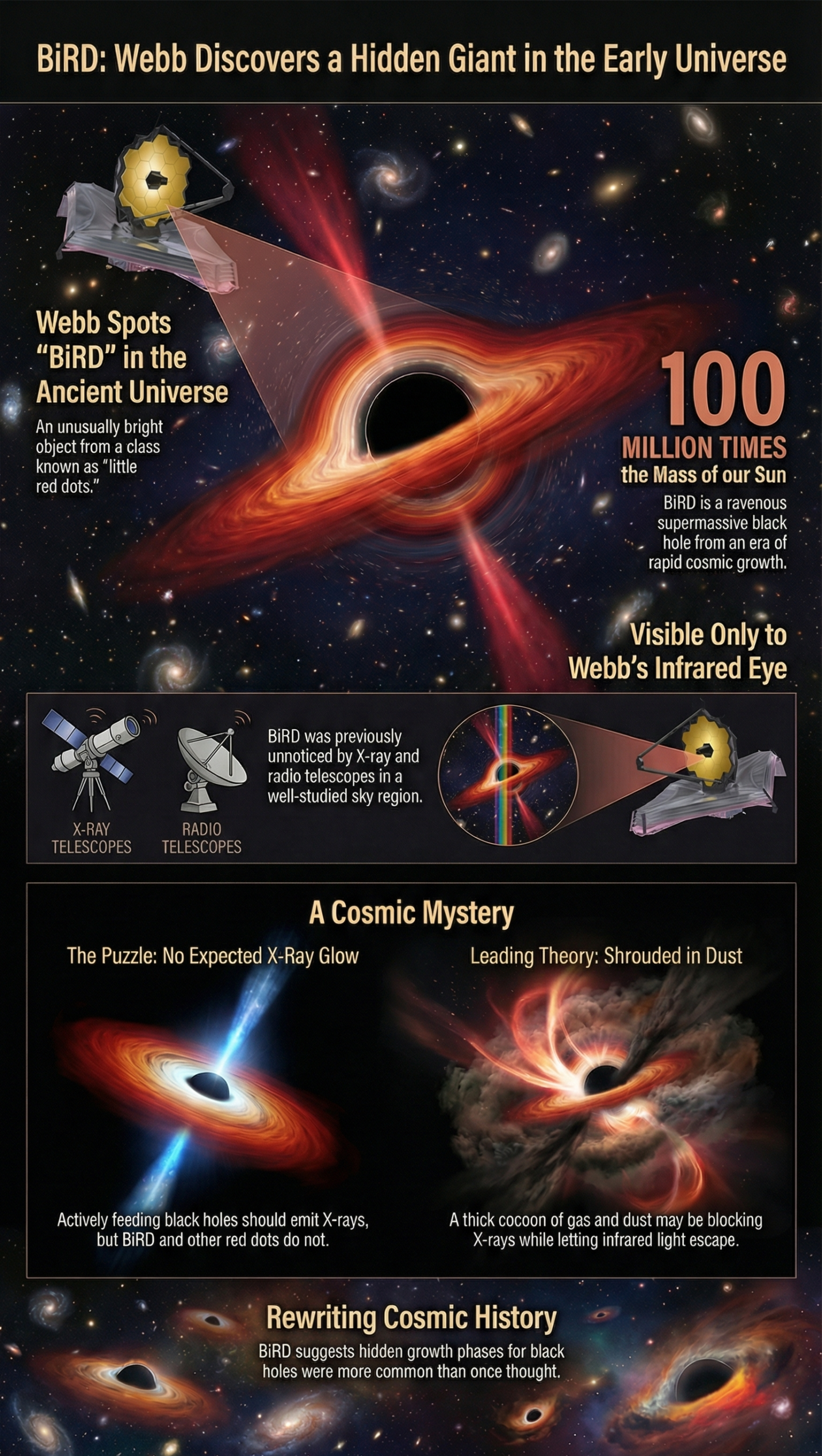
These spectral markers allowed astronomers to measure BiRD’s distance and estimate the mass of its central black hole at roughly 100 million times the mass of the Sun. The observations also indicate dense surrounding gas, consistent with an actively feeding black hole whose high-energy radiation is partially blocked by dust.
James Webb Cosmic Noon Black Hole and the Mystery of “Little Red Dots”
BiRD belongs to a growing group of objects known as “little red dots”—compact, infrared-bright sources discovered by JWST in the early universe. Many astronomers suspect these objects represent an early growth phase of supermassive black holes.
A key puzzle is their weak X-ray emission, which contradicts expectations for actively accreting black holes. One leading explanation is that these black holes are still embedded in thick shells of gas and dust that absorb X-rays while allowing infrared light to escape. BiRD closely matches this model and shares striking similarities with only two other known objects at the same cosmic distance.
James Webb Cosmic Noon Black Hole and What Comes Next
The discovery of BiRD suggests that little red dots did not fade away by cosmic noon, as previously thought, but may have remained common during this peak era of galaxy growth. This finding has important implications for understanding how black hole “seeds” evolve into the supermassive black holes seen today.
Researchers now aim to study a larger population of nearby little red dots in greater detail. With JWST continuing to survey the infrared universe, astronomers expect to refine models of black hole formation and uncover more hidden objects from this critical phase of cosmic history.
Credits
• Research led by the National Institute for Astrophysics (INAF) using data from the James Webb Space Telescope (NASA / ESA / CSA)
• Results published in Astronomy & Astrophysics (October 2025)
• Information summarized from publicly released mission statements and observatory updates
Have any thoughts?
Share your reaction or leave a quick response — we’d love to hear what you think!
-
 0
0
-
2
-
2
-
4
-
0
-
0


