
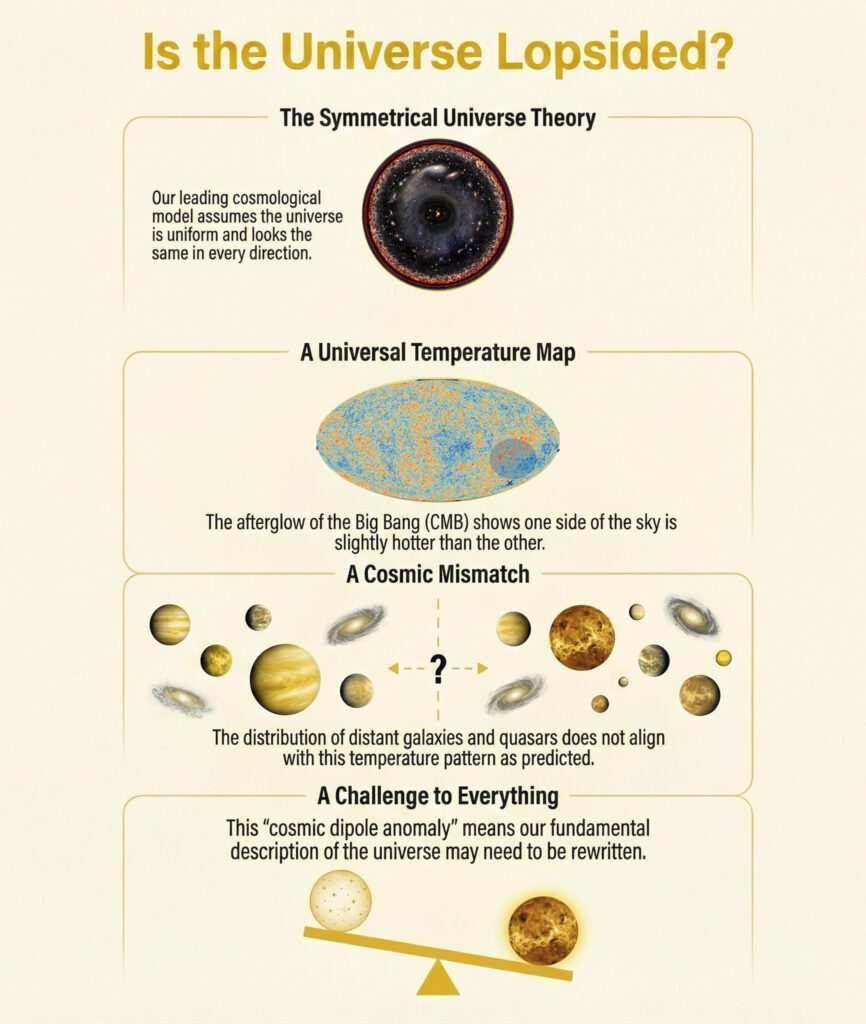
New theoretical and observational research suggests the universe may not be perfectly symmetric after all. A growing body of evidence points to a phenomenon known as the cosmic dipole anomaly, which implies that the large-scale universe may be slightly lopsided rather than uniform in all directions. This challenges a core assumption underlying modern cosmology and its most widely used model. The key issue to watch is whether future observations confirm this asymmetry, potentially forcing scientists to rethink how the universe is structured at the most fundamental level.
Context & Background on cosmic dipole anomaly
The cosmic dipole anomaly arises from a simple but powerful question: does the universe look the same in every direction when viewed on the largest possible scales? For decades, cosmology has assumed the answer is yes. This assumption—known as isotropy and homogeneity—is embedded in the standard cosmological framework that describes the universe’s expansion, structure, and evolution.
At the heart of this framework is the Lambda–Cold Dark Matter (ΛCDM) model, which relies on a mathematically symmetric description of spacetime derived from Einstein’s general theory of relativity. This description, called the FLRW metric, treats the universe as smooth and uniform when averaged over immense distances.
However, several observational “tensions” have emerged in recent years, where independent measurements fail to agree. While the Hubble tension has received widespread attention, the cosmic dipole anomaly cuts even deeper—because it directly questions whether the foundational assumption of cosmic symmetry is valid at all.
Scientific Details Behind cosmic dipole anomaly
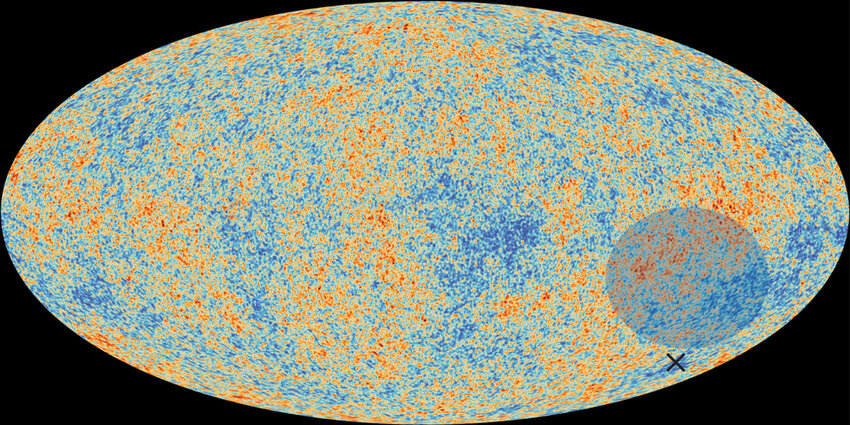
The investigation of the cosmic dipole anomaly begins with the cosmic microwave background, the faint afterglow of the Big Bang. Measurements show this radiation is remarkably uniform, with temperature variations of only about one part in 100,000. This uniformity strongly supports a symmetric universe.
Yet embedded within this background is a prominent feature known as the CMB dipole anisotropy. One side of the sky appears slightly warmer and the opposite side slightly cooler, with a difference of about one part in a thousand. This effect is usually explained as the result of Earth’s motion relative to the cosmic rest frame.
If this explanation is complete, then the same directional pattern should also appear in the distribution of distant matter—such as radio galaxies and quasars—across the universe. This expectation forms the basis of a test proposed in the 1980s, now known as the Ellis–Baldwin test.
Recent datasets, finally large and precise enough to apply this test robustly, indicate a mismatch. The dipole pattern observed in the distribution of distant matter does not align with the dipole measured in the cosmic microwave background, even when accounting for observational uncertainties.
What the New Observations Reveal About cosmic dipole anomaly
The latest studies show that the universe appears to fail the Ellis–Baldwin test. Independent observations—from ground-based radio surveys and space-based infrared measurements—consistently reveal a matter dipole that differs in both magnitude and direction from what the standard model predicts.
This consistency across instruments, wavelengths, and methodologies significantly reduces the likelihood that the result is due to measurement bias or local contamination. Instead, it suggests the anomaly reflects a genuine large-scale feature of the universe.
If confirmed, this would imply that the universe’s large-scale structure is not fully captured by a symmetric cosmological model. In simple terms, the universe may have a preferred direction—a subtle but profound departure from long-held assumptions.
What This Means for Astronomy and Future Research on cosmic dipole anomaly
The implications of the cosmic dipole anomaly are far-reaching. If the universe is not isotropic, cosmologists may need to move beyond the FLRW framework that underpins ΛCDM. This would affect how scientists interpret cosmic expansion, dark energy, and the growth of structure over time.
Such a shift would not merely tweak existing models—it would require rebuilding cosmology from first principles. New theoretical approaches, potentially incorporating anisotropic geometries or previously unexplored physics, would be needed.
Future missions and observatories are expected to play a decisive role. Data from Euclid, SPHEREx, the Vera C. Rubin Observatory, and the Square Kilometre Array will dramatically increase the precision of large-scale sky surveys. These datasets may either confirm the anomaly or reveal a deeper explanation hidden within cosmic evolution.
Additional Insights, Related Phenomena, or Observational Notes on cosmic dipole anomaly
Historically, cosmology has advanced by confronting anomalies rather than ignoring them. The discovery of cosmic acceleration and dark energy emerged from similar mismatches between theory and observation. The cosmic dipole anomaly may represent another such inflection point.
Advances in machine learning and data-driven modeling could also prove essential. With incoming surveys generating unprecedented volumes of data, AI-based techniques may help uncover subtle patterns that traditional analyses overlook, offering new pathways toward a revised cosmological model.
Whether the universe is fundamentally lopsided or whether a deeper, as-yet-unrecognized mechanism restores symmetry remains an open question—but one that sits at the frontier of modern cosmology.
Sources & Credits
• Research contributions originally published via The Conversation
• Observational data from the Planck collaboration
• Information summarized from publicly available research, mission updates, and observatory releases.
Have any thoughts?
Share your reaction or leave a quick response — we’d love to hear what you think!
-
 0
0
-
0
-
0
-
0
-
0
-
0


