
A Dramatic Hubble View of NGC 1792
A tilted spiral galaxy fills the scene with chaotic beauty—patchy arms, bright blue star clusters, glowing red nebulae, and thick dust lanes winding through the disc. Light from NGC 1792 extends into the dark background, where foreground and distant stars scatter across the frame.
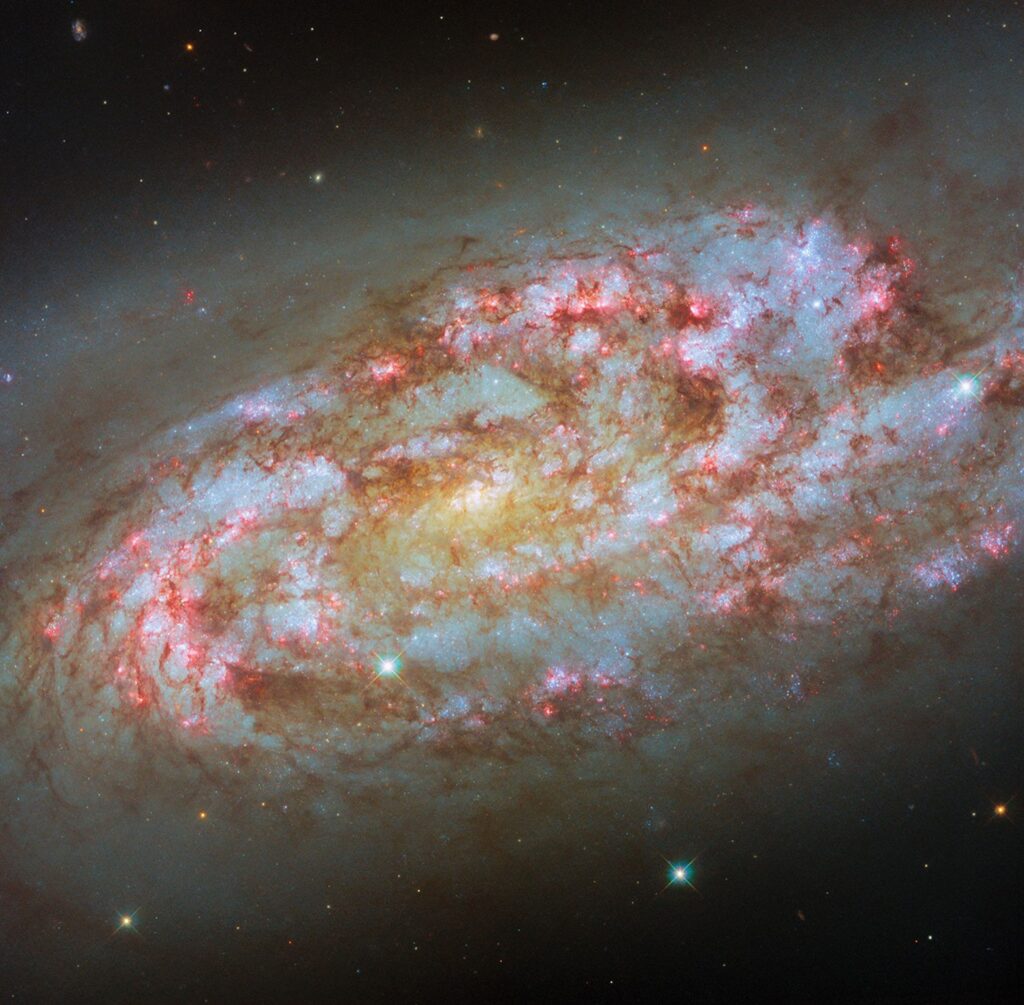
ESA/Hubble & NASA, D. Thilker, F. Belfiore, J. Lee and the PHANGS-HST Team
This NASA/ESA Hubble Space Telescope image captures NGC 1792, a highly active spiral galaxy located 50+ million light-years away in the constellation Columba.
Why NGC 1792 Is a Starburst Galaxy
NGC 1792 is classified as a starburst galaxy—a system undergoing rapid, concentrated star formation.
Key features that define its extreme behavior:
- Unusually high star-formation rate for its size
- Exceptionally bright luminosity relative to galaxy mass
- Dense reservoirs of gas in its spiral arms
- Frequent stellar nurseries and young clusters visible in ultraviolet and infrared data
This intense activity makes NGC 1792 an important target for studying how galaxies evolve during starburst phases.
Gravitational Interaction Fuels Star Formation
Astronomers believe the galaxy’s star-forming frenzy is triggered by its close interaction with its larger neighbor, NGC 1808.
Gravitational forces between the galaxies:
- Disturb gas clouds inside NGC 1792
- Drive compression that ignites new star-forming regions
- Intensify activity on the side facing NGC 1808
- Create turbulent structures across the disc
These interactions offer critical insight into how galaxy pairs reshape each other’s internal dynamics.
New Hubble Data Reveals Deeper Detail
Although Hubble has observed NGC 1792 in the past, this new release incorporates additional datasets acquired throughout 2025, giving astronomers a more detailed look at the galaxy’s internal processes.
A standout feature is the widespread H-alpha emission across the galaxy’s arms:
- Produced when ultraviolet radiation from newborn stars ionizes hydrogen gas
- Emits a distinct red wavelength
- Acts as a reliable indicator of active star formation
- Highlights the locations of the youngest stellar regions
These glowing red signatures trace the ongoing stellar “storm” shaping NGC 1792.
Why This Galaxy Matters for Astrophysics
NGC 1792 serves as a natural laboratory for exploring:
- Galaxy interactions and tidal forces
- Starburst-driven feedback, including stellar winds and supernovae
- Gas dynamics in turbulent spiral arms
- The lifecycle of stellar nurseries and massive clusters
Such environments help astronomers understand how galaxies transform over cosmic time.
Source: NASA Hubble Mission Team — Goddard Space Flight Center
Have any thoughts?
Share your reaction or leave a quick response — we’d love to hear what you think!
-
 1
1
-
0
-
0
-
0
-
0
-
0


