Physical Address
304 North Cardinal St.
Dorchester Center, MA 02124
Physical Address
304 North Cardinal St.
Dorchester Center, MA 02124

NASA's Hubble Space Telescope has detected a new 10-sided atmospheric wave encircling Saturn's south pole, the first such jet pattern seen in the planet's southern hemisphere.
 BySandy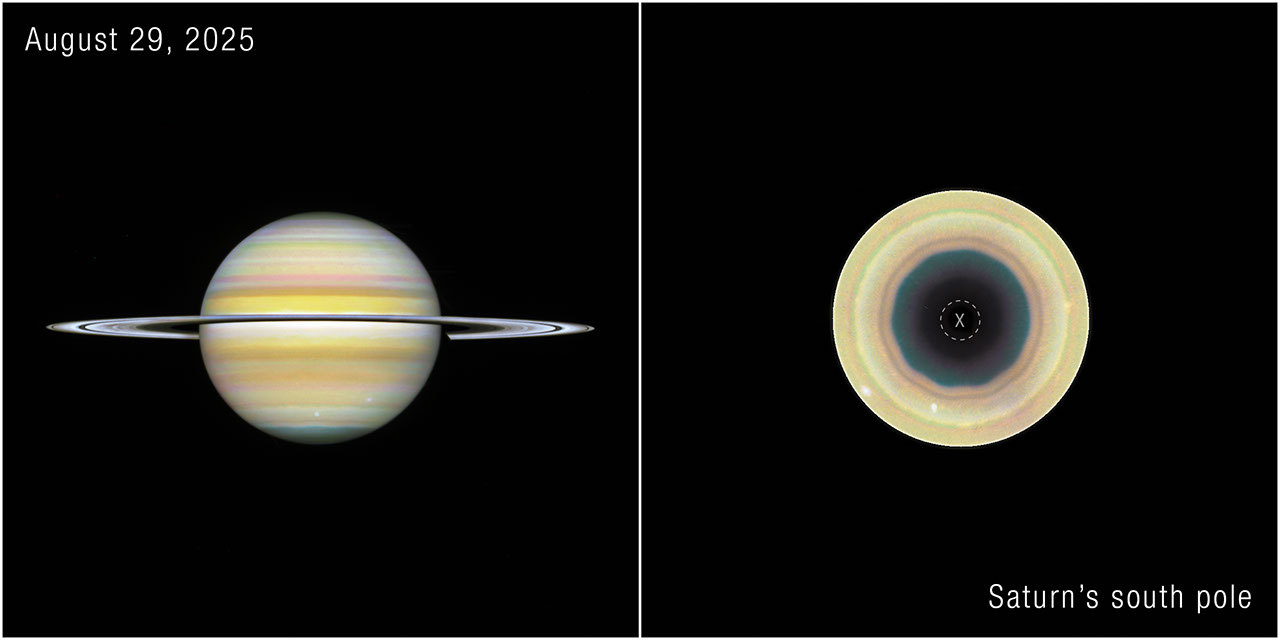
NASA’s Hubble Space Telescope has detected a giant, evolving 10-sided atmospheric wave encircling Saturn’s south pole, the first time astronomers have observed a large, regular-sided jet pattern in the planet’s southern hemisphere. The structure, published Sept. 2 in the journal Science Advances, resembles Saturn’s famous hexagon at the north pole but behaves differently enough that researchers say they may be watching a new atmospheric phenomenon take shape in real time.
The discovery began not with Hubble but with ground-based images submitted by amateur astronomers. Agustín Sánchez-Lavega, the study’s lead author and a researcher at the University of the Basque Country, manages a website called the Planetary Virtual Observatory Laboratory that collects Saturn images from observers worldwide. In 2024, Sánchez-Lavega and amateur astronomers Trevor Barry and Jean-Paul Oger noticed a subtle undulating band along Saturn’s southern pole in that ground-based imagery. Additional images gathered in 2025 strengthened the case for a decagon-shaped structure, prompting the team to request follow-up observations from Hubble.
Hubble’s Outer Planet Atmospheres Legacy (OPAL) program, which has photographed the outer planets annually for more than a decade, provided the sharper view needed to confirm the pattern. By piecing together several years of OPAL images, researchers traced subtle hints of the ten-sided wave back to 2023, before it became clearly defined. Hubble’s position above Earth’s atmosphere gives it unmatched image sharpness and lets it capture full rotations of Saturn without atmospheric blurring, according to NASA’s Goddard Space Flight Center.
“We’ve never seen anything quite like this in Saturn’s southern hemisphere,” said Amy Simon, OPAL principal investigator at NASA Goddard. “The northern hexagon has been there every time we’ve looked for more than 40 years. This feature is different, it appears to be strengthening, giving us the rare opportunity to watch a giant atmospheric pattern develop.”
A jet stream is a fast-moving current of gas that circles a planet at a fixed latitude, and the decagon sits inside one of Saturn’s most powerful examples of one. The wave extends through multiple layers of the atmosphere, indicating it is not merely a cloud-level feature but a vertically extended atmospheric structure, per NASA. Hubble captured the pattern using multiple wavelengths of light, and the decagon’s apparent position shifts slightly between them because different wavelengths probe different altitudes in Saturn’s atmosphere.
Images from NASA’s Cassini spacecraft, which orbited Saturn between 2004 and 2017, showed no sign of a long-lived formation at the south pole, according to Sánchez-Lavega. “Given Saturn’s symmetry in its north-south jet stream system, we have been searching for a counterpart to Saturn’s northern hexagon on the south pole in Hubble images since 1990,” he said. “Images from the Cassini spacecraft showed no inkling of a long-lived formation, either. The Hubble data confirmed the feature’s presence back to 2023.”
Saturn’s slow, decades-long seasonal cycle only recently brought its south pole back into view from Earth, which is part of why the decagon has only now become detectable. But the pattern’s apparent formation date still puzzles the research team. “The most intriguing part to me is that this seems to have just formed recently,” Simon said. “The question is, why did it suddenly form now when we haven’t seen one before?”
The team, including co-author Mike Wong of the University of California, Berkeley, says further observations from Hubble and the James Webb Space Telescope, combined with atmospheric modeling, are needed to determine how the decagon formed and whether it will persist like its northern counterpart. Wong noted that many OPAL discoveries emerge not from a single observation but from years of accumulated data, and that regular monitoring continues to turn up new findings.
The finding underscores what more than three decades of continuous Hubble observation can reveal: not single snapshots but slow-building patterns that only emerge across years of repeated monitoring. The OPAL program’s annual surveys of the outer planets were designed for exactly this kind of long-term tracking, and researchers say the decagon is a reminder that even well-studied planets like Saturn can still surprise. Whether the new pattern settles into a stable, hexagon-like fixture or fades as Saturn’s seasons continue to shift remains an open question for future observing campaigns, one the OPAL team plans to keep watching year over year.
Source: NASA Goddard Space Flight Center and the Hubble Space Telescope’s Outer Planet Atmospheres Legacy (OPAL) program, operated in partnership with ESA and the Space Telescope Science Institute. Published in: Science Advances. Primary source: https://science.nasa.gov/missions/hubble/nasas-hubble-tracks-new-decagon-encircling-saturns-south-pole/.
Further Reading: OrbitGeo’s coverage of Saturn’s northern hexagon, and OrbitGeo’s explainer on the Hubble OPAL program.