Physical Address
304 North Cardinal St.
Dorchester Center, MA 02124
Physical Address
304 North Cardinal St.
Dorchester Center, MA 02124

 BySandy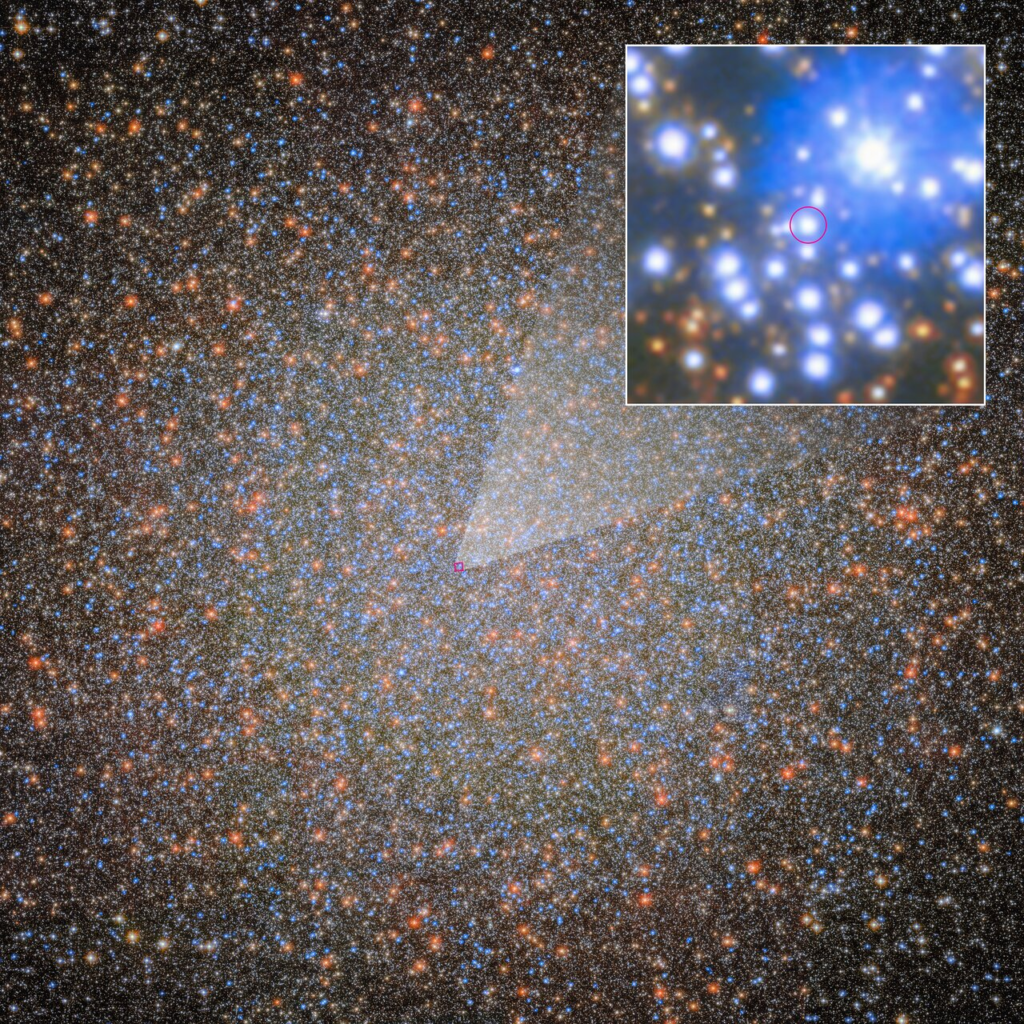
Astronomers have detected the first stellar-mass black hole within Omega Centauri, the Milky Way’s largest globular cluster, using more than two decades of archival data from the Hubble Space Telescope combined with near-infrared observations from the James Webb Space Telescope. The object, designated oMEGACat BH-2, has a mass of 4.46 solar masses and orbits a companion star once every 94 years — the longest orbital period ever recorded for a black hole binary.
Omega Centauri is a dense collection of roughly 10 million gravitationally bound stars, located about 18,000 light-years from Earth and estimated to be 12 billion years old. Astronomers have long suspected the cluster’s core hosts an intermediate-mass black hole, which Hubble data helped confirm in a separate 2024 study.
Models predict the cluster should also contain around 10,000 smaller, stellar-mass black holes — remnants left behind by exploding stars. That population has evaded detection in past studies relying on the radial velocity method, which tracks Doppler shifts in a star’s light, or searches for radio and X-ray emission from material falling onto a black hole.
The team, led by Matthew Whitaker of the University of Utah, took a different approach: astrometry, which measures the precise positions and small movements of stars over time. By sifting through more than 20 years of Hubble archival data spanning 2002 to 2023, and adding recent Webb near-infrared observations to sharpen the measurements, the researchers tracked a star orbiting an invisible object too massive to be anything but a black hole.
“With the Hubble and Webb data, we were able to see the motion of the visible main sequence star that is part of this binary, which is about 18,000 light-years away in the dense environment of Omega Centauri,” Whitaker said. “The precision of these measurements is incredible, down to a fraction of a pixel on Hubble and Webb’s detectors.”
The visible companion star has a mass of 0.78 solar masses. Tracking its wobble let the team calculate the mass of its unseen partner at 4.46 solar masses — too heavy to be a neutron star, ruling out a prior study’s suggestion that the object was one. But that mass is lower than models predict for a metal-poor environment like Omega Centauri.
“Its mass is actually much lower than would be expected in a metal-poor environment. This is surprising and exciting,” said Anil Seth, also of the University of Utah and a coauthor of the study. “We now know that a metal-poor star should be able to form a black hole like this, and we need to figure out how.”
The star completes one orbit around oMEGACat BH-2 every 94 years, the longest orbital period documented for any known black hole binary. That long period points to how the pair likely formed: dynamically, meaning the star and black hole did not originate together but found each other later within the crowded cluster.
The researchers calculate a system like this one will survive for less than a billion years before nearby stellar encounters tear it apart — a small fraction of Omega Centauri’s roughly 12-billion-year age.
Understanding how black holes form and pair up inside globular clusters bears directly on how astronomers interpret gravitational-wave detections from observatories such as LIGO. Dense, ancient environments like Omega Centauri are considered leading candidates for where merging black hole binaries originate.
“Environments like Omega Centauri are the primary places where we think binaries are merging and creating these waves,” Seth said. Maximilian Häberle, a postdoctoral fellow at the European Southern Observatory who led the Hubble and Webb data reduction, called the find “the second breakthrough from our oMEGACat astrometric re-analysis,” following the cluster’s intermediate-mass black hole confirmation.
The detection of oMEGACat BH-2 confirms that Omega Centauri’s predicted black hole population is real and detectable, even if most remain unseen. It also shows that decades-old telescope archives, reanalyzed with newer instruments, can still yield discoveries that targeted searches have missed — a template the team plans to apply as it keeps searching for the cluster’s other black holes.
SOURCE ATTRIBUTION
Source: ESA/Hubble — Hubble Space Telescope Program, in collaboration with the University of Utah
Published in: The Astrophysical Journal Letters
Primary source: https://esahubble.org/news/heic2610/