Physical Address
304 North Cardinal St.
Dorchester Center, MA 02124
Physical Address
304 North Cardinal St.
Dorchester Center, MA 02124

A four-telescope composite of the Tarantula Nebula reveals up to half its hot gas is leaking out through the star-forming region's shell walls.
 BySandy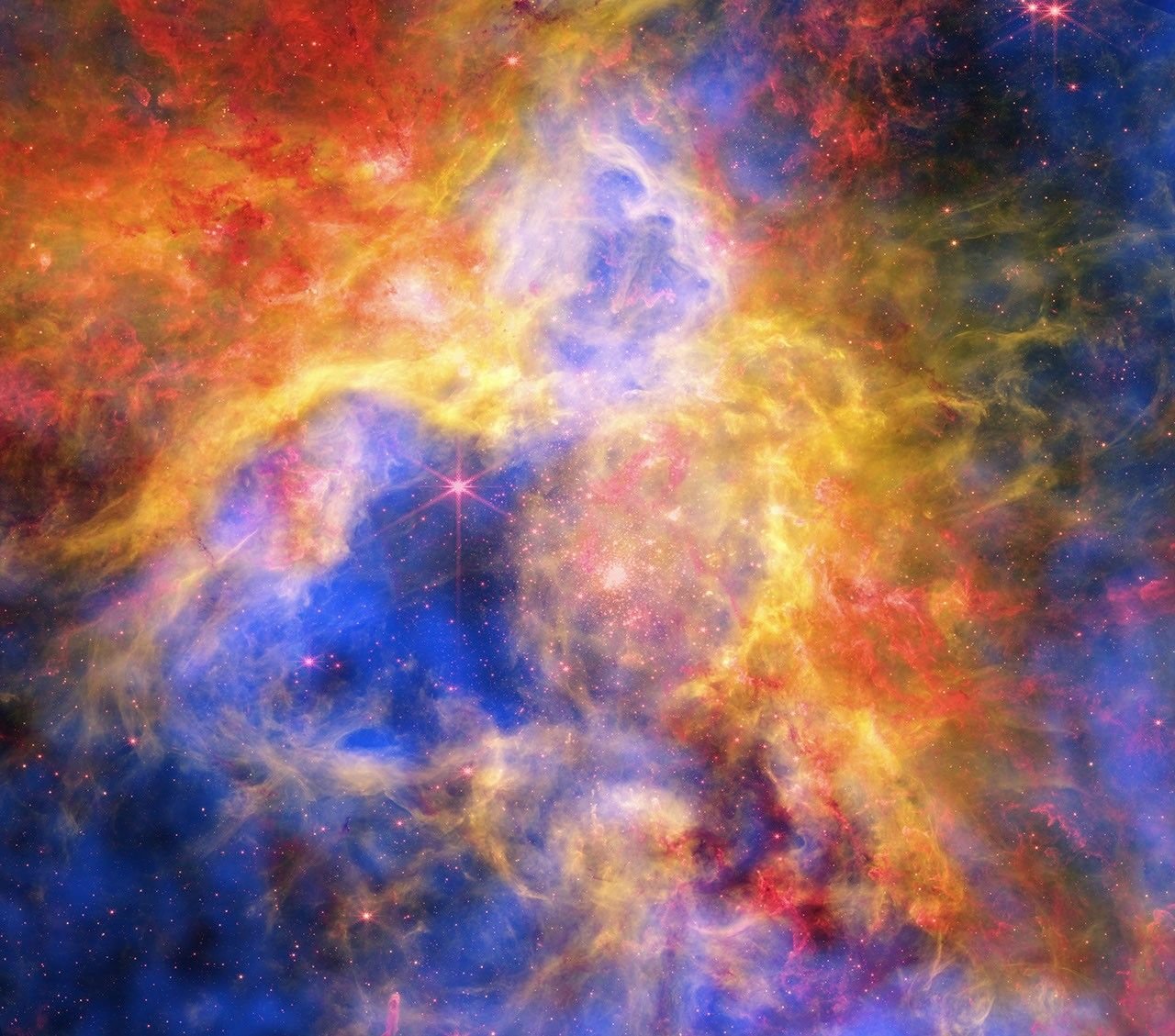
A composite image combining data from four NASA space telescopes has resolved a long-standing puzzle in the Tarantula Nebula: why the star-forming region emits far less X-ray radiation than models of its young, massive stars predict. The findings, led by Jennifer Rodriguez of Ohio State University, were published in the Astrophysical Journal.
The Tarantula Nebula, also known as 30 Doradus, sits in the Large Magellanic Cloud, a small neighbor galaxy to the Milky Way roughly 160,000 light-years from Earth. It hosts thousands of young stars arranged in a honeycomb-like structure of gas and dust and ranks among the brightest and largest star-forming regions visible from Earth.
Winds from the surfaces of young, massive stars in the Tarantula should generate shock waves that heat surrounding gas to millions of degrees, producing strong X-ray emission. NASA’s Chandra X-ray Observatory has repeatedly observed the nebula over its mission, but researchers found far less X-ray-emitting gas than their models predicted. That discrepancy left an open question: where did the missing energy go?
To answer it, Rodriguez’s team combined Chandra’s X-ray data with infrared observations from the James Webb Space Telescope, optical data from the Hubble Space Telescope, and archival data from NASA’s retired Spitzer Space Telescope. In the resulting composite, Chandra’s X-rays appear in blue, tracing gas heated by stellar winds and shock waves. Webb’s infrared data appears in red, revealing thousands of embedded young stars and the cool dust that will eventually seed new stars and planets. Hubble’s optical data fills in green, showing hydrogen gas warmer than what Webb detects, along with individual stars scattered through the nebula.
The team concluded the Tarantula Nebula loses energy through three simultaneous channels. Up to half of the hot, X-ray-emitting gas is leaking out through the shell walls of the surrounding gas and dust structures and escaping the nebula entirely. Turbulent mixing between the hot gas and cooler gas near the shell walls lowers the overall temperature of the mixture. And comparisons with computer simulations point to thermal conduction, direct physical contact between hot and cooler material that equalizes their temperatures without mixing, similar to how a frying pan transfers heat to food without the two substances blending.
Together, these three processes account for the energy that should have shown up as X-ray emission but did not, explaining why the Tarantula appeared to have lost its fire in X-ray observations despite its population of massive, wind-driving stars.
The research paper was led by Jennifer Rodriguez of The Ohio State University in Columbus. Additional authors include Laura Lopez of Ohio State, Lachlan Lancaster of Columbia University in New York City, Anna Rosen of San Diego State University, Omnaraynai Nayak of the Space Telescope Science Institute in Baltimore, Sebastian Lopez of Ohio State, Tyler Holland-Ashford of NASA’s Goddard Space Flight Center in Greenbelt, Maryland, and Trinity Webb of Ohio State. NASA’s Marshall Space Flight Center in Huntsville, Alabama, manages the Chandra program, with the Smithsonian Astrophysical Observatory’s Chandra X-ray Center controlling science operations from Cambridge, Massachusetts, and flight operations from Burlington, Massachusetts.
The composite image was released by NASA on August 11, 2026, and includes the full Hubble and Webb fields of view alongside a large section of the Chandra data, with all three telescopes’ observations overlapping in the nebula’s central region to produce a blended view spanning red, orange, yellow, green, and blue.
The result offers a template for studying energy budgets in other massive star-forming regions across the galaxy and beyond, where similar gaps between predicted and observed X-ray emission have puzzled astronomers. By combining X-ray, infrared, optical, and archival data from four observatories, the team demonstrated that gas leakage, turbulent mixing, and thermal conduction can together account for energy that single-telescope studies had left unexplained.
Source: NASA, Marshall Space Flight Center / Chandra X-ray Observatory program. Published in: The Astrophysical Journal. Primary source: https://science.nasa.gov/missions/chandra/nasa-telescopes-create-colorful-craft-from-nearby-nebula/.