Physical Address
304 North Cardinal St.
Dorchester Center, MA 02124
Physical Address
304 North Cardinal St.
Dorchester Center, MA 02124

A new Chandra, Webb, and Hubble composite of the Tarantula Nebula helped astronomers determine that up to half its hot, stellar-wind-heated gas is escaping undetected.
 BySandy
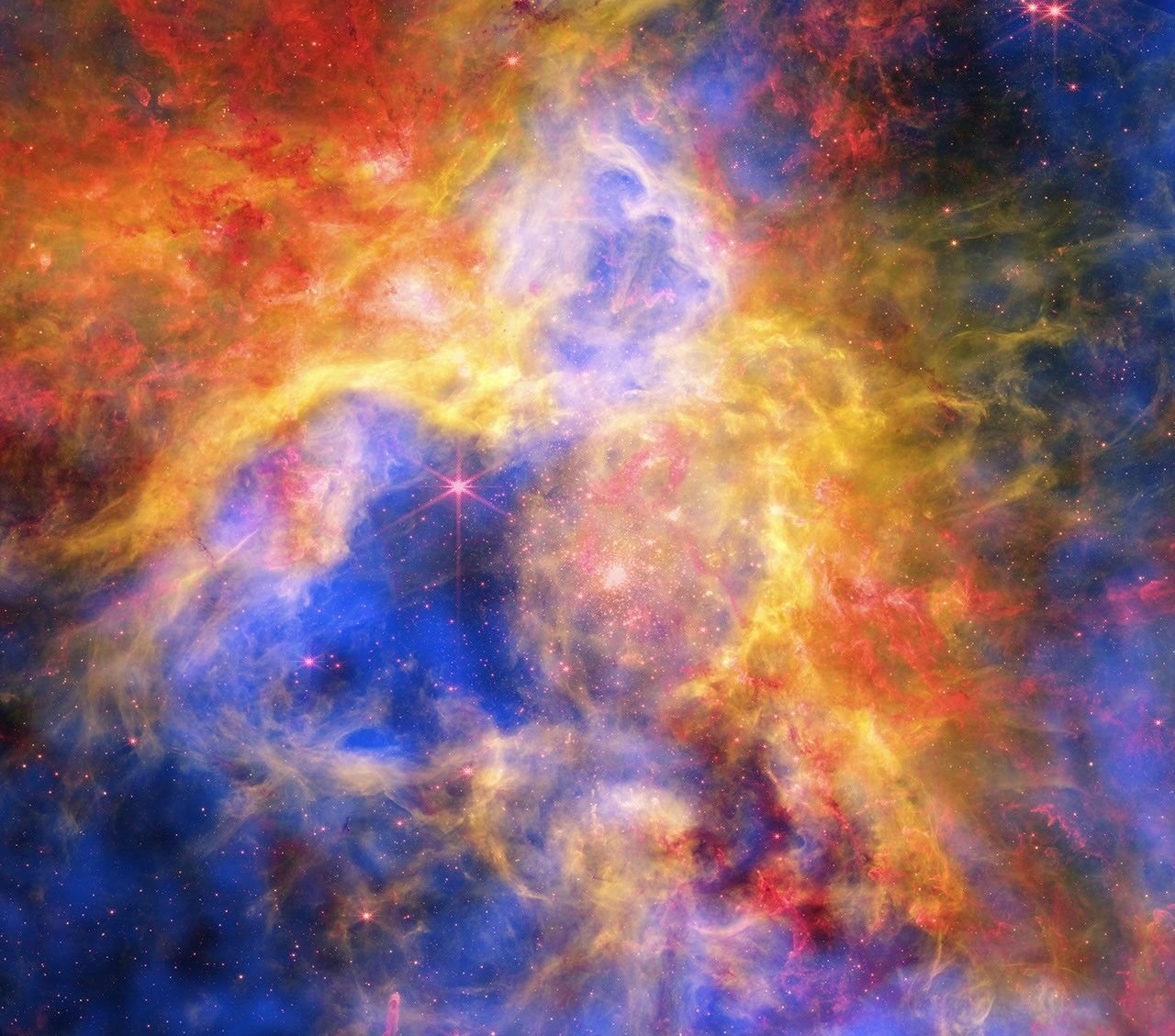
A new composite image combining NASA’s Chandra X-ray Observatory, James Webb Space Telescope, and Hubble Space Telescope has helped astronomers explain a longstanding puzzle in the Tarantula Nebula: why the region contains far less X-ray-emitting hot gas than the energy pouring out of its young, massive stars should produce. The findings, published in The Astrophysical Journal, were led by Jennifer Rodriguez of Ohio State University.
The Tarantula Nebula, also called 30 Doradus, sits in the Large Magellanic Cloud, a small neighbor galaxy to the Milky Way located about 160,000 light-years from Earth. It is one of the brightest and largest star-forming regions visible from our galaxy, filled with thousands of young stars embedded in a honeycomb-like structure of gas and dust.
The new composite layers observations from three NASA space telescopes, each tuned to a different type of light. Chandra’s X-ray data, shown in blue, reveals gas blown away by winds from the surfaces of young, massive stars and heated to millions of degrees by shock waves, similar to sonic booms produced by supersonic jets. Webb’s infrared data, shown in red, reveals thousands of young stars along with swaths of cool dust that will eventually provide raw material for new stars and planets. Hubble’s optical data, shown in green, reveals hydrogen gas warmer than what Webb detects, along with individual stars scattered through the nebula.
In some parts of the image, the Chandra layer stands alone. In others, it combines with either the Webb or Hubble data, and in the nebula’s central region all three datasets overlap to produce a mix of red, orange, yellow, green, and blue.
Astronomers have long studied the energy that winds from young, massive stars pump into the Tarantula Nebula’s surrounding gas. That energy should heat much of the gas enough to produce X-rays, but Rodriguez’s team found significantly less X-ray-emitting gas than expected. That gap raised a direct question: where did the missing energy go, and what “tamed” the Tarantula Nebula?
To answer it, the researchers combined the new Chandra, Hubble, and Webb data with archival observations from NASA’s retired Spitzer Space Telescope. Their analysis points to three separate channels through which the nebula appears to be losing energy.
First, the team found that up to half of the hot gas may be leaking directly through the shell walls of the nebula’s gas and dust structures and escaping the region entirely. Second, they identified stirring and mixing between cooler gas near the shell walls and the hot interior gas, which lowers the overall temperature of the mixture.
The third channel involves conduction, a process in which hot and cooler material in direct physical contact gradually equalize in temperature, similar to a frying pan losing heat to a burner. Comparisons with computer simulations suggest that in the Tarantula Nebula’s densest regions, hot gas may be losing energy this way through direct contact with cooler gas in the shells, a process distinct from the mixing described above.
Together, these three loss mechanisms, leakage, mixing, and conduction, offer a physical explanation for the shortfall between the energy young stars are expected to inject into their surroundings and the amount of X-ray-emitting gas actually observed.
The research draws on data from Chandra, Hubble, Webb, and Spitzer, illustrating how observations gathered by different telescopes over different missions can be combined to answer questions no single observatory could resolve alone. NASA’s Marshall Space Flight Center in Huntsville, Alabama, manages the Chandra program, while the Smithsonian Astrophysical Observatory’s Chandra X-ray Center controls science operations from Cambridge, Massachusetts.
Understanding how young, massive stars redistribute and lose energy to their surroundings helps astronomers refine models of stellar feedback, the process by which newborn stars regulate future star formation in the gas clouds around them. Because the Tarantula Nebula is one of the closest and most active starburst regions to the Milky Way, it serves as a nearby laboratory for processes that likely shaped star formation throughout the early universe, when such intense star-forming regions were far more common.
Source: NASA Marshall Space Flight Center / Chandra X-ray Center, Smithsonian Astrophysical Observatory (research led by Jennifer Rodriguez, Ohio State University). Published in: The Astrophysical Journal. Primary source: https://science.nasa.gov/missions/chandra/nasa-telescopes-create-colorful-craft-from-nearby-nebula/.
]]>