Physical Address
304 North Cardinal St.
Dorchester Center, MA 02124
Physical Address
304 North Cardinal St.
Dorchester Center, MA 02124

NASA's IXPE and NICER measured X-ray polarization nearly three times higher than similar magnetars, offering astronomers the most definitive evidence yet for a 90-year-old quantum prediction.
 BySandy
NASA’s IXPE (Imaging X-ray Polarimetry Explorer) has measured X-ray polarization from the magnetar 1E 1547.0-5408 at levels nearly three times higher than seen in comparable objects, a signal researchers describe as the most definitive evidence yet for vacuum birefringence, a 90-year-old prediction of quantum electrodynamics. The results, published August 5 in Nature, represent the first coordinated radio and X-ray polarization measurement ever made of a magnetar.
Between March and April 2025, IXPE devoted more than 140 hours to observing 1E 1547.0-5408, a magnetar that completes a full rotation every 2 seconds. NASA’s NICER (Neutron Star Interior Composition Explorer) and Murriyang, the CSIRO Parkes radio telescope in Australia, observed the same source at the same time, producing the first-ever coordinated radio and X-ray polarization dataset for a magnetar.
Magnetars are neutron stars with the strongest magnetic fields of any object in the observable universe, more than a trillion times stronger than the most powerful permanent magnets built on Earth. 1E 1547.0-5408 drew the research team’s attention because it consistently emits bright radio and X-ray light at the same time, a combination scientists are still working to explain.
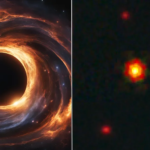
The polarization IXPE recorded, the degree to which incoming X-ray photons align in a single orientation, measured nearly three times higher than similar magnetars. The magnetar’s magnetic field geometry predicted the signal should approach zero at certain points in its rotation. Standard models of X-ray emission from a neutron star’s surface could not explain the elevated values either, indicating that another effect was boosting the polarization.
The team’s modeling found X-ray polarization reaching 40% in one emission zone and 80% in another, each tied to a distinct “hot spot” offset from the star’s magnetic axis. That excess pointed to a physical effect beyond what the star’s surface alone could produce.
Vacuum birefringence was proposed in 1936, within the theoretical framework that became quantum electrodynamics. The theory holds that inside an extremely powerful magnetic field, the vacuum of space stops behaving as truly empty: virtual particle pairs briefly forming and annihilating cause it to act like a prism, altering the polarization of light depending on the direction it travels.
Detecting the effect requires magnetic fields far beyond anything achievable on Earth, which is why magnetars — natural laboratories with fields more than 100 million times stronger than the strongest lab magnets — are the only place scientists can search for it. Hoa Dinh Thi, a postdoctoral associate at Rice University and co-lead author of the study, said the team’s models show that reproducing the observed X-ray polarization, while also satisfying constraints from the radio data, requires the presence of vacuum birefringence in the neutron star’s surrounding environment.
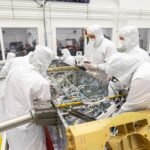
IXPE is a joint mission of NASA and the Italian Space Agency, led by NASA’s Marshall Space Flight Center in Huntsville, Alabama, with partners and science collaborators in 12 countries. It is the first space telescope built specifically to measure X-ray polarization, a capability distinct from earlier X-ray missions that measured only brightness and energy.
Rachael Stewart, a Ph.D. candidate at George Washington University and lead author of the Nature paper, said the measurement links the interior structure of a distant neutron star to fundamental physics that cannot be tested in any laboratory on Earth. “The information we obtained from looking at this distant star core also gives us clues about the nature of the fabric of reality as we know it,” Stewart said. Further IXPE observations of 1E 1547.0-5408 and other magnetars are planned to confirm the signal and search for additional quantum electrodynamic effects.
The result does not close the case on vacuum birefringence. The research team describes it as the most definitive signal to date, not a final confirmation. But it demonstrates that magnetars can function as particle-physics laboratories, extending tests of quantum electrodynamics into a magnetic-field regime no experiment on Earth can reach.
Source: NASA — Marshall Space Flight Center / IXPE Mission. Published in Nature. Primary source: science.nasa.gov.