Physical Address
304 North Cardinal St.
Dorchester Center, MA 02124
Physical Address
304 North Cardinal St.
Dorchester Center, MA 02124

NASA's Hubble Space Telescope imaged the N44 nebula in the Large Magellanic Cloud, revealing a superbubble spanning roughly 210 by 140 light-years across, carved by massive stars.
 BySandy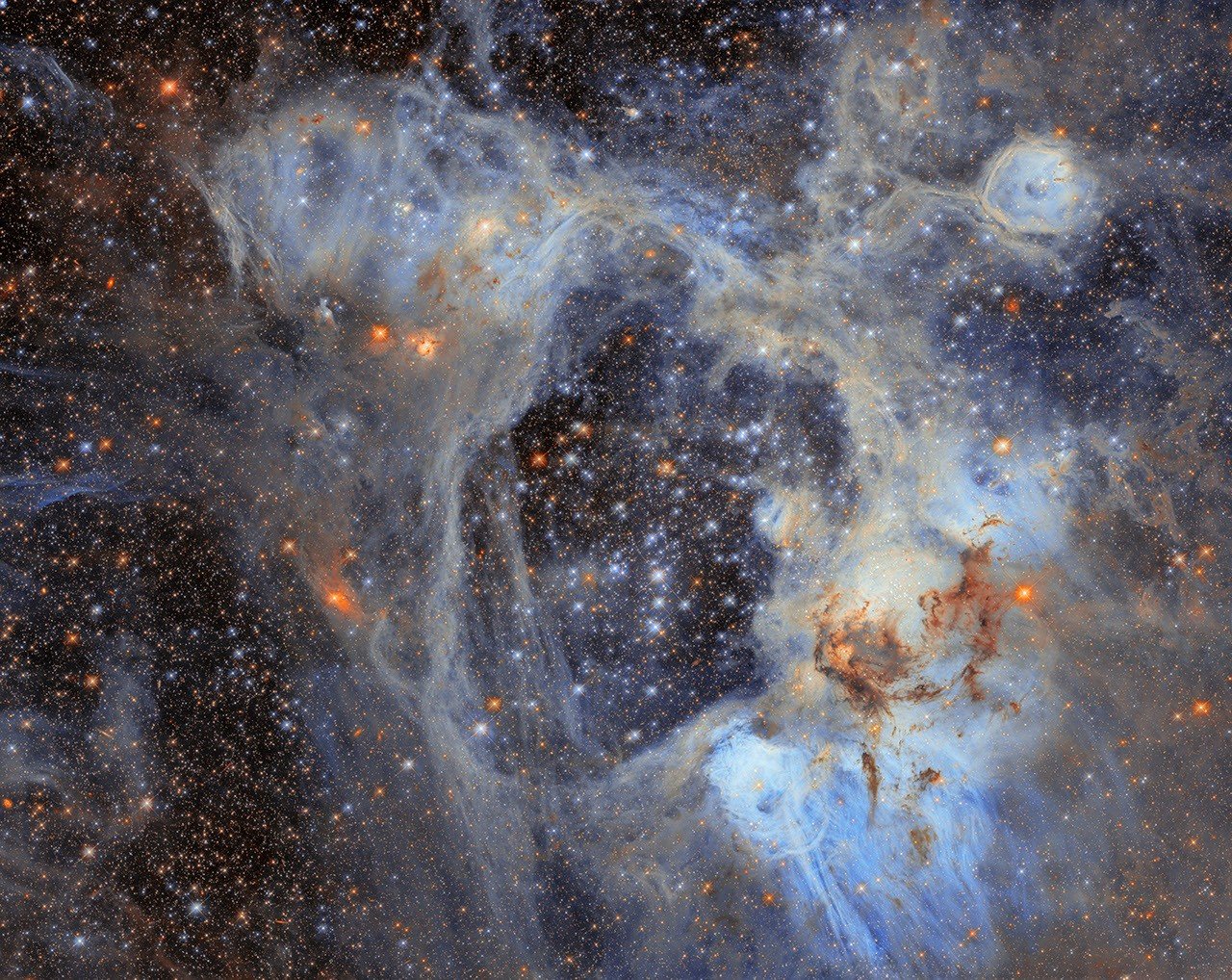
NASA’s Hubble Space Telescope has captured a detailed portrait of N44, a star-forming nebula in the Large Magellanic Cloud that contains a superbubble spanning roughly 210 by 140 light-years. Released by NASA on September 3, 2026, the image shows a shell of dense, dusty gas wrapped around a vast central void, carved out by the combined stellar winds and supernova explosions of massive stars at the nebula’s core.
The Large Magellanic Cloud, the largest of the small galaxies orbiting the Milky Way, sits just 160,000 light-years from Earth, close enough for Hubble to resolve individual stars within its star-forming regions. N44, formally cataloged as LHA 120-N44, lies in the constellation Dorado and is dominated by two features: a central superbubble and the dense gas shell that surrounds it.
The stars at the center of the void are responsible for creating it. Through stellar winds, the continuous outflow of charged particles streaming from a star’s surface, and explosive supernovae, these stars expelled much of the gas from which they were born, hollowing out the 210-by-140-light-year cavity. As the expelled gas swept outward, it compressed into the shell now visible around the void’s edge. New stars are forming within that compressed gas today, making N44 an active target for astronomers studying how stars form in this kind of environment.
The image draws on data from Hubble observing program #14689, led by principal investigator D. Gouliermis, which surveyed N44 to catalog its stellar population. The program identified nearly half a million stars within the cluster, along with interloper stars drifting in front of it.
Of the stars surveyed, nearly 30,000 are pre-main-sequence stars, meaning they have not yet begun fusing hydrogen into helium in their cores, the process that powers ordinary stars for most of their lives. Detecting this population required Hubble’s high sensitivity and fine spatial resolution, which let astronomers pick out faint, low-mass objects within N44’s crowded stellar field. Researchers are using the catalog to determine how long star formation takes in this environment, from the collapse of cold gas clouds into dense knots to the ignition of nuclear fusion inside a newborn star. That timeline is difficult to measure directly, since the process unfolds over hundreds of thousands to millions of years, far longer than any single observing campaign, so astronomers instead compare stars at different stages within the same cluster to reconstruct the sequence.
The broader N44 complex contains several smaller structures first cataloged by astronomer Karl Henize in the 1950s. One of them, designated N44F, appears near the upper right of the new image as a distinct, smaller bubble. N44F was blown by the intense stellar winds and radiation of a single hot, massive star, whose output has sculpted the surrounding gas into pillars of dusty material, a structure Hubble imaged in close-up in an earlier release focused specifically on that feature.
The Large Magellanic Cloud contains fewer elements heavier than helium, what astronomers call “metals,” than the Milky Way does, a chemical makeup similar to galaxies in the early universe. Studying how the lowest-mass stars in N44 form under these conditions gives astronomers a nearby proxy for star formation in the young cosmos, where metal-poor environments were the norm rather than the exception. Hubble’s sensitivity to faint, low-mass stars makes N44 a useful laboratory for that comparison, since fewer heavy elements affect how efficiently gas cools and collapses into new stars.
The N44 dataset adds to a growing body of Hubble observations documenting how massive stars regulate the interstellar material around them, shaping the conditions in which future generations of stars form. As astronomers continue to analyze the roughly half a million stars cataloged in program #14689, the work extends a record of how gas clouds collapse into stars across galaxies with limited heavy-element content, connecting a nearby galactic neighbor to the processes that shaped the earliest generations of stars in the universe.
Source: NASA, Goddard Space Flight Center, Hubble Space Telescope Mission. Text Credit: ESA/Hubble. Primary source: https://science.nasa.gov/missions/hubble/nasas-hubble-spies-superbubble-scene/.