Physical Address
304 North Cardinal St.
Dorchester Center, MA 02124
Physical Address
304 North Cardinal St.
Dorchester Center, MA 02124

NASA's Swift Observatory confirmed a supermassive black hole shredding a star 30,000 light-years from its host galaxy's core, the most distant such event yet found.
 BySandy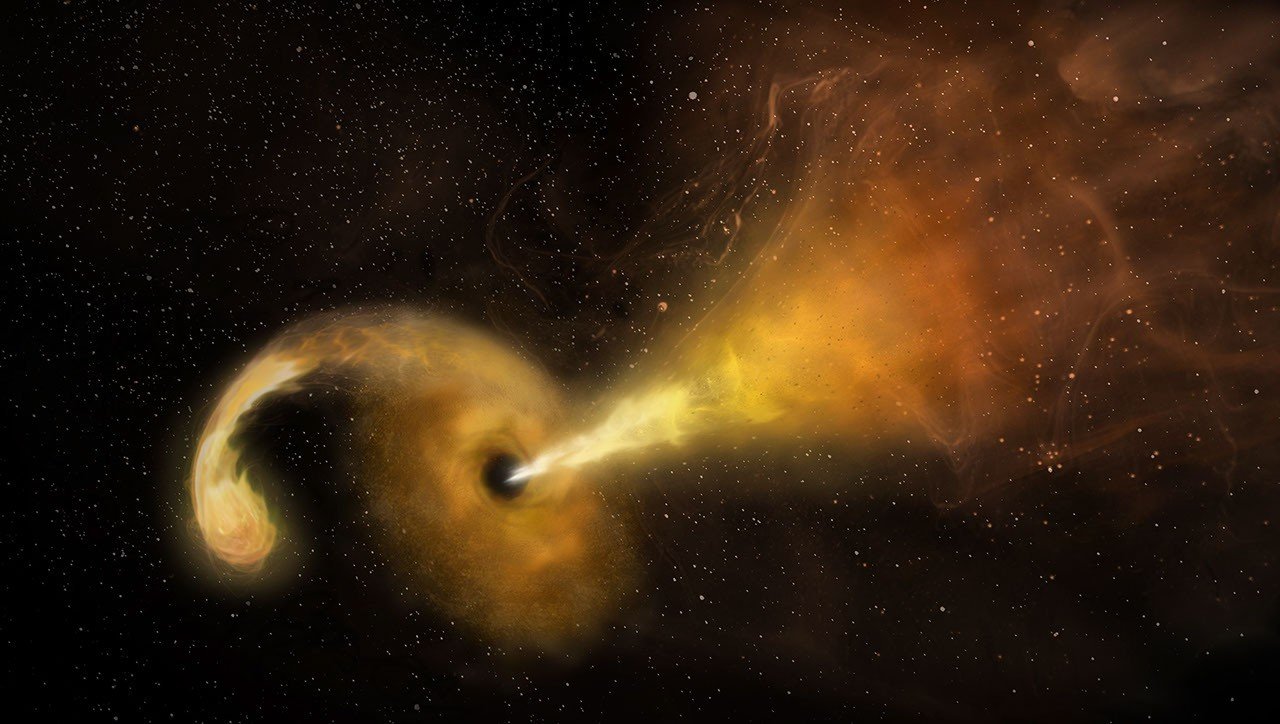
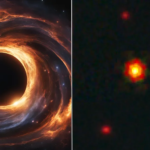
NASA’s Neil Gehrels Swift Observatory has confirmed a supermassive black hole ripping apart a star roughly 30,000 light-years from the center of its host galaxy, the most distant such event from a galactic core ever recorded. The black hole, weighing about a million times the mass of the Sun, was not anchored at the galaxy’s center where such objects normally reside. The findings, published in The Astrophysical Journal Letters, mark one of just a handful of confirmed cases of a wandering supermassive black hole caught in the act of destroying a star.
The event, known as a tidal disruption event, occurs when a star drifts too close to a black hole and is ripped apart by extreme gravitational forces. Researchers led by Robert Stein, a research fellow at the University of Maryland, College Park, and NASA’s Goddard Space Flight Center, were specifically searching for these star-shredding flares as a way to find otherwise invisible supermassive black holes wandering away from galactic cores. “With this discovery, which is one of just a couple that have been confirmed so far, we’ve validated a new technique and can use it to hunt for more,” Stein said.
The black hole’s existence was first flagged in November 2025 as an unusual brightening in a galaxy about 750 million light-years away, identified by ZTF, the Zwicky Transient Facility, a survey conducted at Palomar Observatory in Southern California. “Out of the half million flashes ZTF detects each night, our new artificial intelligence algorithm automatically recognized a flare that looked a lot like a tidal disruption event, despite its unusual location in the outskirts of a galaxy,” Stein said. For several months, the flare outshone its entire host galaxy in ultraviolet light, temporarily radiating with the brightness of about 10 billion suns.
Follow-up observations with the SOAR (Southern Astrophysical Research) telescope in Chile examined the event’s spectrum and found features consistent with a tidal disruption event. Jonathan Carney, a doctoral student at the University of North Carolina at Chapel Hill who took the first spectra supporting that interpretation, helped confirm the classification despite its unusual location. NASA’s Swift then measured the flare in wavelengths ground-based telescopes cannot detect. Swift’s UVOT (Ultraviolet/Optical Telescope) instrument measured the event’s temperature at about 54,000 degrees Fahrenheit, or 30,000 degrees Celsius, data that, combined with the spectra, ruled out other explanations for the flare.
Nearly every galaxy in the universe is anchored by a supermassive black hole at its center, and about once every 100,000 years a star drifts close enough to trigger a tidal disruption event. Before 2024, these events had only been observed in galaxy cores, largely because that is where astronomers were looking. That changed after scientists identified a star being shredded 2,600 light-years from a galaxy’s center, which prompted researchers to search beyond galactic cores. The newly confirmed event, at roughly 30,000 light-years from its galaxy’s center, extends that search more than tenfold. Stein and his colleagues have proposed two explanations: the black hole may have been flung to the galaxy’s edge after three or more galaxies merged and their central black holes engaged in a gravitational tug-of-war, or a smaller dwarf galaxy could be midway through merging with the larger one, with a star straying too close to the dwarf’s own black hole in the process.
Swift’s pointed observations are temporarily suspended while the spacecraft, whose primary mission ran from 2004 to 2006, awaits an orbit boost planned to counteract decades of atmospheric drag. Once operations resume, the observatory could continue the search for out-of-place black holes. Researchers also plan to apply the technique using the newly operational Vera C. Rubin Observatory in Chile and NASA’s upcoming Nancy Grace Roman Space Telescope, both of which are expected to expand the search for tidal disruption events considerably. “Rubin’s wide, deep surveys will reveal a much larger sample of tidal disruption events than current observatories are capable of collecting, including ones that are off-center,” said Carney.
How common wandering supermassive black holes are remains an open question, one that additional detections should help answer. Each confirmed case adds to a small but growing census of black holes that have been displaced from the centers of their galaxies, offering astronomers a new way to trace the violent merger histories that shaped galaxies over cosmic time.
Source: NASA’s Goddard Space Flight Center, Neil Gehrels Swift Observatory. Published in: The Astrophysical Journal Letters. Primary source: https://science.nasa.gov/missions/swift/nasas-swift-sees-wandering-mega-black-hole-shredding-star/.