Physical Address
304 North Cardinal St.
Dorchester Center, MA 02124
Physical Address
304 North Cardinal St.
Dorchester Center, MA 02124

A Yale-led team using the new MOTHRA telescope found 22 bow shocks in the Helix Nebula's outer halo, capturing dying-star debris being broken apart in real time.
 BySandy
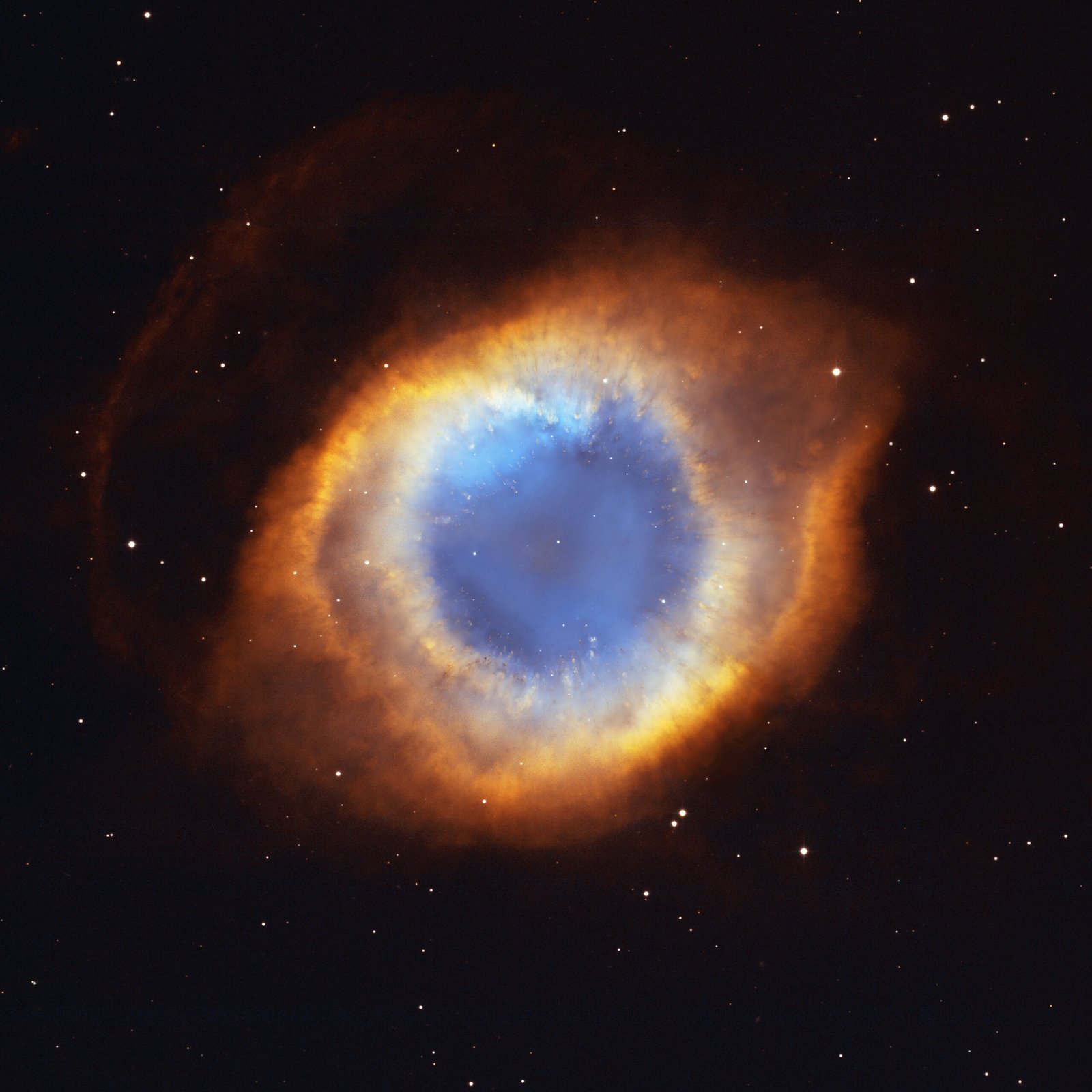
A research team led by Yale astronomer Pieter van Dokkum has captured an unprecedented image of a dying star’s debris being broken apart and absorbed into interstellar space. Using a new telescope called MOTHRA, the researchers found 22 complete or partial “bow shocks” in the faint outer halo of the Helix Nebula, a well-studied planetary nebula roughly 650 light-years from Earth in the constellation Aquarius.
The findings were published August 12, 2026, in the journal Nature, and describe what the team calls a rare, direct glimpse of the “handoff” between recognizable stellar debris and the diffuse gas that fills the space between stars.
The researchers were not looking for bow shocks when they found them. They had selected the Helix Nebula, one of the best-known nebulae in the sky, as a convenient target for calibrating MOTHRA, short for the Modular Optical Telephoto Hyperspectral Robotic Array. The instrument combines images from hundreds of telephoto lenses to detect faint, diffuse ionized gas, and it is under construction at the El Sauce Observatory in Chile’s Rio Hurtado Valley, where it will eventually operate an array of 1,140 telephoto lenses.
“We thought we were taking a calibration image of one of the best-known nebulae in the sky,” said study co-author Roberto Abraham of the Dragonfly Focused Research Organization and the University of Toronto. “Instead, we found this extraordinary network of bow-shaped structures. It was immediately clear that the faint outer Helix was telling us a story that had largely been missed.”
The Helix Nebula’s bright inner ring, its most familiar feature, formed from material expelled by a dying white dwarf star at its center. The new MOTHRA observations reached far beyond that bright core into an extraordinarily faint outer halo, where the team identified the 22 bow shocks on the nebula’s eastern side.
A bow shock takes a shape similar to the wave that forms in front of a moving boat. In the Helix Nebula, mostly invisible clumps of stellar debris are moving rapidly through the thin gas that fills interstellar space, and the glowing arcs mark where those clumps collide with the surrounding gas.
The shocks change shape with distance from the central star. Those closest to the nebula’s core are large, thin, and sharply defined, while those farther out grow smaller, fuzzier, and increasingly fragmented. The researchers interpret this progression as direct evidence that the clumps are being steadily eroded as they travel outward.
Based on this progression, the team estimates that an individual fragment of stellar debris remains coherent for roughly 10,000 years once it is exposed to the surrounding interstellar gas. After that period, its material is largely shredded and mixed into the diffuse gas between the stars, becoming raw material available for future generations of stars and planets.
“We are seeing material shed near the end of a star’s life being broken apart and returned to the galaxy,” said van Dokkum, the Sol Goldman Family Professor of Astronomy at Yale and lead author of the study. “That handoff, from recognizable stellar debris to the diffuse gas between the stars, has been very difficult to observe. Far in the future, the Sun will go through a similar process, and its material will enter the same cycle.”
MOTHRA builds on concepts van Dokkum and Abraham first developed for the Dragonfly Telephoto Array, an earlier instrument located in the mountains of New Mexico that combines images from multiple lenses to detect the dim glow of faint stars and galaxies. MOTHRA significantly expands that approach, adding far more lenses along with new filters and computational power. The research was funded and supported by Alex Gerko, founder and chief executive of the algorithmic trading firm XTX Markets.
“This is only the beginning of what we’ll be able to see with MOTHRA,” van Dokkum said.
The observations mark one of the few times astronomers have directly traced the transition from a recently ejected stellar shell to fully mixed interstellar material, a process that recycles the elements needed to build new stars, planets, and, eventually, the ingredients of life. As MOTHRA’s full array of 1,140 lenses comes online, the team expects to extend this kind of observation to other nearby planetary nebulae, filling in a stage of the stellar life cycle that has largely gone unseen.
Source: Yale University / Dragonfly Focused Research Organization (research led by Pieter van Dokkum, Yale Department of Astronomy). Published in: Nature. Primary source: https://news.yale.edu/2026/08/12/dying-star-offers-rare-glimpse-how-universe-recycles-its-raw-materials.
]]>