Physical Address
304 North Cardinal St.
Dorchester Center, MA 02124
Physical Address
304 North Cardinal St.
Dorchester Center, MA 02124

As a total solar eclipse crossed Greenland, Iceland, and Spain on August 12, 2026, NASA flew a high-altitude jet and dozens of scientific balloons to study the Sun's corona and its effects on Earth's atmosphere.
 BySandy
A total solar eclipse swept across Greenland, Iceland, and Spain on August 12, 2026, and NASA-funded scientists chased the Moon’s shadow with a research jet and a fleet of scientific balloons to make the most of the brief window when the Sun’s corona became visible.
The path of totality also crossed a small area of northeastern Portugal before continuing over the north Atlantic. According to the European Space Agency, it was the first total solar eclipse visible from mainland Spain since 1905, and the first of three solar eclipses expected to cross the country between 2026 and 2028.
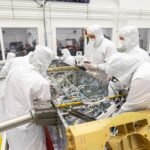
NASA’s WB-57 high-altitude research aircraft flew at 50,000 feet, above any clouds that could obscure the view, carrying a four-camera instrument called the SCIFLI Multispectral Airborne Imager, or SAMI. Built by the NASA Scientifically Calibrated In-Flight Imagery team at Langley Research Center, the cameras capture at least 20 images per second across visible and infrared wavelengths.
Because the jet can chase the eclipse path at roughly 460 miles per hour, its view of the corona lasted nearly three minutes, compared with two minutes and 18 seconds for observers on the ground. Flying above the lower atmosphere also let the cameras record infrared wavelengths that would otherwise be absorbed before reaching the ground, wavelengths that have only been observed a handful of times before.
Amir Caspi of the Southwest Research Institute in Boulder, Colorado, is the principal investigator behind the SAMI instrument, which also flew during the April 8, 2024, total solar eclipse. “The Sun is always changing,” Caspi said. “Every eclipse is different. So we could see things we didn’t see before. And we learn from each eclipse how to better observe the next one.” His team adjusted camera exposure times for 2026 after some bright features were overexposed during the 2024 flight.
Scientists hope the imagery will help them understand how solar prominences form, how the corona is heated to nearly a million degrees, and how material in the corona relates to the solar wind streaming outward across the solar system. The effort is funded by NASA’s Heliophysics Low Cost Access to Space Program.
On the ground and in the air below the jet, the NASA-supported Nationwide Eclipse Ballooning Project, led by Angela Des Jardins at Montana State University, sent student teams from several U.S. universities to Iceland and Spain. In Iceland, two teams launched a combined 80 balloons beginning 18 hours before the eclipse and continuing eight hours after it, tracking changes in Earth’s boundary layer, the lowest part of the atmosphere that touches the ground.
Previous eclipse ballooning campaigns in October 2023 and April 2024 found that the boundary layer collapsed in locations with clear skies but not where clouds were present. “Will this eclipse be able to collapse the boundary layer?” asked Matthew Bernards, a University of Idaho engineering professor leading one of the Iceland teams, noting that Iceland’s long August days may weaken the effect compared with past eclipses.
In Spain, three balloon teams launched six balloons carrying 360-degree cameras to photograph the Moon’s shadow from above, along with instruments measuring atmospheric ozone, which requires sunlight to form. Similar measurements during the 2024 eclipse showed ozone levels dropping during totality.
The European Space Agency hosted a live broadcast from the Observatorio Astrofísico de Javalambre in Teruel, Spain, hosted by Dame Dr Maggie Aderin and featuring ESA Director of Science Carole Mundell. ESA also ran a free public observation program in León, Spain, in partnership with the University of León.
“A total solar eclipse is one of those rare moments when millions of people can look up together and feel both wonder and curiosity,” Mundell said. “It is a shared moment that connects us to the universe.”
The eclipse was not visible as total anywhere in the United States, though parts of the country saw a partial eclipse. NASA streamed coverage from Iceland and Spain through its live broadcast channels.
Source: NASA Heliophysics, with the European Space Agency. Primary source: science.nasa.gov.